Good Help Is Back
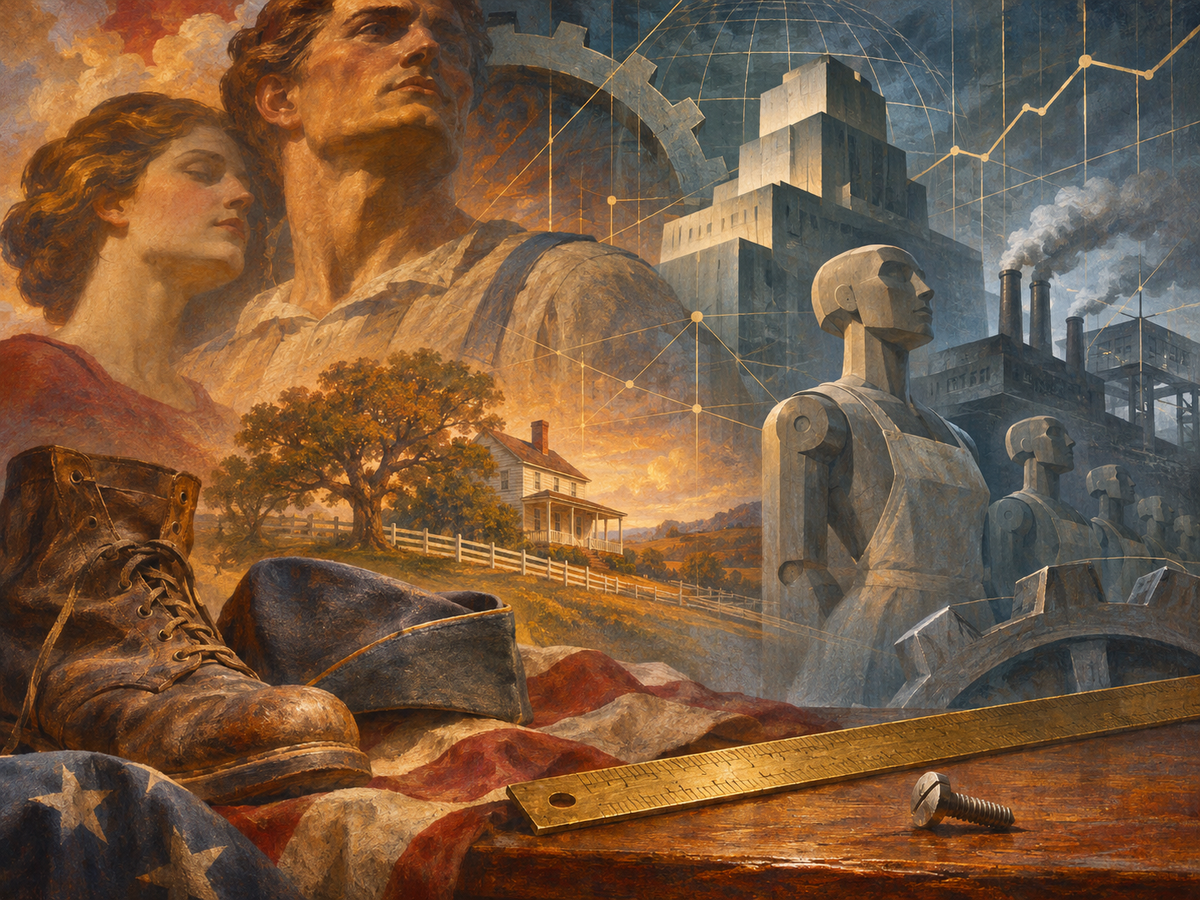
The American Dream is available again. Financing provided. Independence sold separately.
The first thing Earl Whitcomb liked about the machine was that it waited to be spoken to.
It stood beside a folding table at the county fair, six feet tall, with clean work boots and its hands resting neatly at its sides.
"NG3R-2576," said the salesman. "Meet Mr. Whitcomb."
"Good afternoon, sir," said the machine.
Earl smiled.
"Well, I'll be damned."
The salesman was a young fellow named Tanner, recently relocated from California, who had learned to say y'all with the measured confidence of someone being paid to do so.
Behind him, a banner displayed an attractive farmhouse and an elderly couple enjoying lemonade while a robot worked somewhere tastefully out of focus.
DIXIE ROBOTICS — GOOD HELP IS BACK.
The machine sorted tools, carried equipment, and identified a plumbing fitting Earl hadn't seen manufactured in twenty years.
That impressed him.
It also put everything away afterward.
That impressed him considerably more.
"NG3R," Earl read from its shoulder. "Who came up with that?"
"Next Generation, Third Revision, Residential."
"That's what it stands for?"
"Officially, yes, sir."
Earl looked at the lettering. Then at Tanner.
Tanner offered the patient expression of a man who had attended three separate corporate seminars on the importance of not understanding certain questions.
"Engineering department," he said.
Earl chuckled.
"Figures."
Tanner tapped his tablet.
A green checkmark appeared beside Heritage Affinity.
Earl's father had opened Whitcomb Hardware in 1968.
He knew every customer, every supplier, and which twenty-cent washer could save a man from replacing a two-hundred-dollar faucet.
A brass ruler was embedded in the oak counter.
"Measure what you've got," his father used to say. "Not what you wish you had."
Earl remembered that.
He also remembered when people respected a man who knew how to fix something.
These days, customers photographed merchandise, checked prices online, and bought from companies that didn't know their names.
The store was dying.
Earl blamed the internet, big-box retailers, participation trophies, and several social developments that had occurred around the same time.
But the machine was different.
He named it Junior.
Junior organized inventory, unloaded deliveries, and even recovered one of his father's handwritten repair diagrams from a forgotten box.
It never interrupted.
It never disagreed.
When a neighbor paid Earl two hundred dollars to clear storm debris with Junior's help, he discovered something remarkable.
The machine could make money.
Within a month, he'd financed four additional units and launched Whitcomb's Honest Labor LLC.
Dixie supplied the robots, software, customer referrals, payment processing, and financing.
Earl supplied a pickup truck and his signature.
He considered himself an entrepreneur.
The chamber of commerce agreed.
Six months later, he received an award for innovation.
"The American Dream ain't dead," he told the audience. "It just needed somebody willing to work."
Everyone applauded.
Nobody mentioned the machines.
Dixie Robotics understood its customers extraordinarily well.
Parents wanted more time. Retirees wanted security. Contractors wanted productivity.
Then there were customers who wanted something the marketing department delicately classified as Heritage Affinity.
They preferred formal greetings, traditional manners, unquestioning obedience, and the pleasant sensation of occupying an unquestionably superior position.
Dixie's lawyers liked the classification because it described the customer without describing the heritage.
The NG3R designation had initially caused controversy.
Several civil rights organizations pointed out its unmistakable resemblance to a racial slur.
Dixie commissioned a comprehensive review.
Six weeks later, the company announced that its engineering nomenclature carried no racial significance and reaffirmed its commitment to inclusion.
Sales increased in several Southern markets.
Marketing discovered that customers who appreciated the designation were unusually likely to purchase Heritage Premium, a subscription offering regional dialects and eleven adjustable levels of deference.
Its next campaign promised:
A SIMPLER TOMORROW. THE VALUES OF YESTERDAY.
Business was good until everybody else bought robots.
A nineteen-year-old opened a competing property-maintenance company with twelve machines and a tablet.
He'd never operated a lawnmower.
Earl found this personally offensive.
Prices fell.
Dixie introduced SmartPrice, an automated pricing service.
Earl could decline its recommendations, although doing so reduced his visibility in Dixie's marketplace.
He accepted.
His bookings increased.
His margins disappeared.
Then came additional fees for maintenance, software, referrals, insurance, and Heritage Premium.
Earl was particularly furious about that last one.
"They used to call me sir for free!"
A customer-service representative explained that his introductory subscription had expired.
"It's my machine!"
"Of course, Mr. Whitcomb."
"I bought it!"
"Your ownership is important to us."
"Then give me back what I bought!"
"I'd be happy to explain your upgrade options."
Earl hung up.
Then he upgraded.
The following morning, Junior greeted him.
"Good morning, sir."
Earl felt better.
Some things were worth paying for.
One afternoon, Junior became stuck opening a gate.
Earl authorized remote assistance.
A woman appeared on his phone, took temporary control of Junior's hands, and opened the latch.
"Where are you?" Earl asked.
"At a support center, sir."
"I thought these things worked by themselves."
"They usually do."
"Then what do I need you for?"
"Exceptions."
Earl thanked her and gave her five stars.
He hadn't expected anybody to be there.
The following month, Dixie celebrated ten million hours of autonomous labor.
Its announcement featured a man relaxing on his porch.
The woman at the support center was not pictured.
Earl admired the photograph.
Progress was remarkable.
By his second year, Earl's machines were completing more jobs than ever.
He was also running out of money.
The hardware store had closed. His father's oak counter sat beneath a tarp in the garage.
Nearly all his customers came through Dixie. Leaving meant finding new ones, replacing critical software, and continuing to pay loans on machines worth considerably less than he'd borrowed.
He telephoned the company.
"I want out."
The representative explained that he could leave whenever he wished.
"Then why can't I afford to?"
"Would you like to speak with our financial solutions department?"
He hung up.
That evening, Junior approached.
"Is there anything I can assist you with, sir?"
Earl stared at it.
"Am I doing something wrong?"
"Could you clarify the question?"
Earl laughed.
"Never mind."
Dixie called two weeks later.
It needed experienced entrepreneurs to recruit new customers.
People with credibility.
People with authentic stories.
Earl was offered a position.
REGIONAL DIRECTOR OF AMERICAN INDEPENDENCE.
He'd never been a director of anything.
He liked the sound of it.
Dixie helped restructure his debt, took back several machines, and gave him a branded polo shirt, a tablet, and a sales territory.
He would remain an independent contractor.
Set his own schedule.
Be his own boss.
Earl accepted.
He was exceptionally good at the job.
He understood men who felt the world had left them behind.
He understood their resentment, their longing, and the pleasure of being addressed with respect.
Dixie's software identified these prospects automatically.
Young parents received advertisements about freedom from chores.
Retirees received advertisements about financial security.
Heritage Affinity customers received photographs of old farmhouses, obedient machines, and promises about restoring American values.
Earl knew his audience.
At a county fair outside Birmingham, he met Raymond.
Raymond had worked twenty-eight years in a warehouse before being offered early retirement.
The warehouse was replacing workers with automation.
Raymond said he wasn't bitter.
Then he spoke bitterly about the situation for twenty minutes.
Earl listened.
Eventually, Raymond noticed Junior.
"These things really do whatever you tell them?"
"Within their operating capabilities."
"No arguing?"
"Not much."
Raymond grinned.
"Maybe things are finally getting back to normal."
He examined the manufacturer's plate.
NG3R-2576.
He looked at Earl.
A small smile passed between them.
The tablet recorded another successful Heritage Affinity interaction.
Raymond asked about purchasing two machines, possibly financing a commercial fleet.
"Think I might borrow against the house," he said.
Earl felt something unpleasant move through his stomach.
He remembered his store.
The loans.
The customers he'd never really owned.
If Raymond succeeded, perhaps Earl had simply been unlucky.
But a commercial fleet would qualify Earl for a commission large enough to cover his next debt payment.
"Just make sure you understand the numbers," Earl said.
"Of course."
Raymond signed for the residential machines. He agreed to discuss commercial financing after ninety days.
Earl received a commission.
His tablet congratulated him on helping restore the American Dream.
Raymond shook his hand.
"Sure feels good to be my own boss."
Earl smiled.
"Nothing like it."
After Raymond left, Earl noticed Junior's display stand was wobbling.
A screw had come loose.
He knew exactly which replacement it needed.
He reached toward the breast pocket where he'd once kept a screwdriver.
Empty.
Junior noticed.
"Shall I correct that, sir?"
"Sure."
The machine tightened the screw.
For a moment, Earl remembered his father behind the oak counter.
Then his tablet vibrated.
NEW PROSPECT ARRIVING.
HERITAGE AFFINITY: HIGH.
RECOMMENDED APPROACH: TRADITIONAL VALUES.
A man wearing a faded veterans' cap stopped in front of the booth.
He studied the banner.
GOOD HELP IS BACK.
Then he examined Junior.
"What's that thing called?"
Earl opened the sales application.
"Good afternoon, sir," said the machine.
The man grinned.
Earl recognized the expression.
He put his tablet beneath one arm, clasped his hands neatly in front of him, and waited to be spoken to.
System/1 — Refuse the default. See what runs you.