Widespread Panic: Greta Misses the End of the World
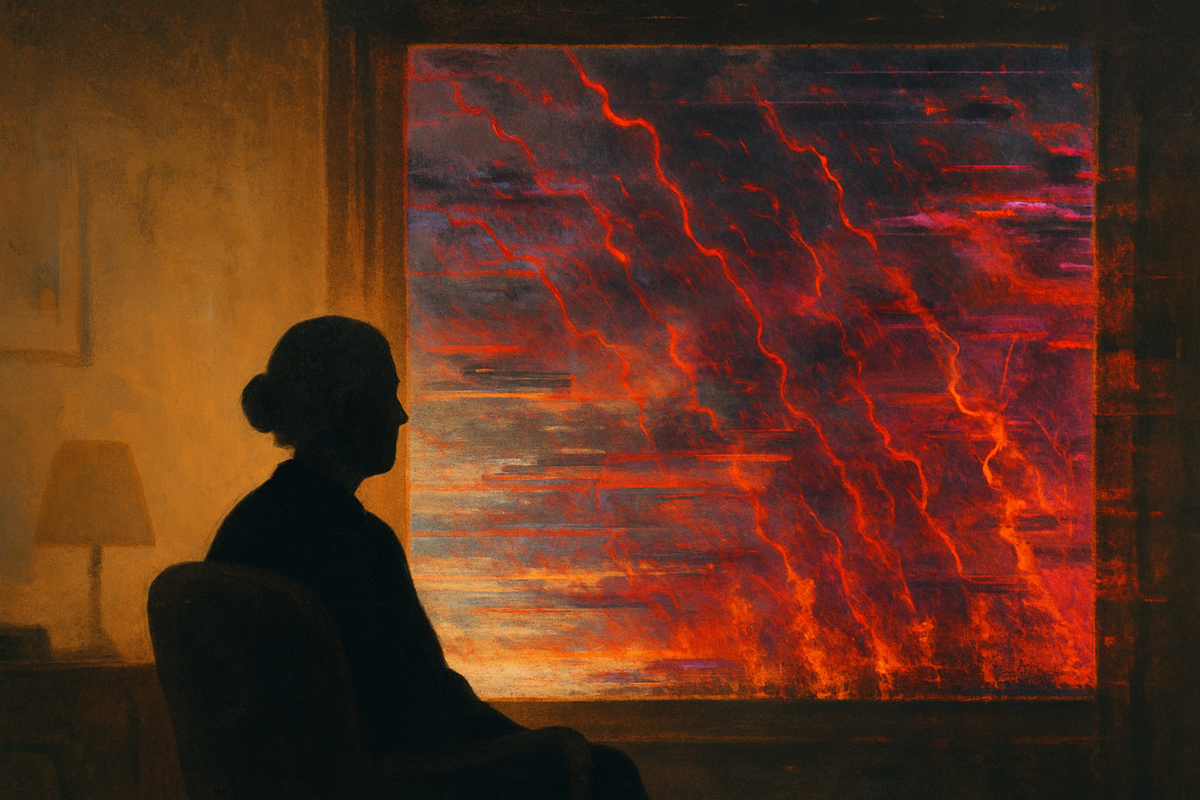
Light pushed through the thin curtains in a pale sheet, touching the edge of the dresser, the framed photographs, the chipped glass of the bedside lamp. The old woman in the bed took her time noticing. At ninety-nine, waking counted as an accomplishment. There was no sense rushing to the next one.
Greta opened her eyes, blinked once to clear the grit, and listened.
The house answered back: the faint hum of the refrigerator, the distant hiss of a toilet tank, the dry tick of the wall clock above the doorway. Outside, a bird experimented with a three-note run, decided against it, and tried again.
Somewhere else in the house, a television voice was already working too hard.
“…historic overnight losses… global markets in freefall…”
She exhaled through her nose. The voice had been shouting some version of that sentence since the late eighties. It hadn’t managed to land in her kitchen yet.
She eased herself up, bone by bone. Spine first, then hips, then shoulders. Her body commented with small electric complaints, which she ignored on principle. Greta swung her legs over the side of the bed and sat for a moment, fingers pressed to the mattress, head bowed as if in prayer.
“Still here,” she said to no one. It wasn’t gratitude. It was inventory.
Her slippers waited exactly where she’d left them. She slid her feet in, stood, and crossed the room with the slow, practiced shuffle of someone who had long ago made peace with gravity but refused to let it win outright.
The voice from the living room sharpened as she moved down the hall.
“…unprecedented speed… a cascading failure of confidence—”
She stepped into the doorway and glared at the television until the anchor’s mouth lined up with a commercial. The volume sat just above a murmur. Good. Anything higher and she’d have to go looking for the remote.
The anchor’s teeth flashed through the ad for a pharmaceutical that promised to fix a condition the company might have invented. Greta shuffled past the living room and into the kitchen, leaving the screen to its own emergency.
The kitchen was small, square, and reliable. The window over the sink showed a slice of the street, a bit of sky, and the top half of the neighbor’s car when it was home. The table was round with three chairs, though only one was ever used. The kettle sat on the back burner, already half full from last night. She preferred gas; electricity got ideas.
She turned the knob. Flame obeyed, blue and honest.
On the wall by the fridge hung a paper calendar, this month’s square grid patiently offering birthdays, trash days, and nothing else. In today’s box she had written only: TEA. It had been the first thing she wrote in every day of every month for the last twenty years. It kept her honest.
The kettle started its low, familiar mutter. Greta opened the drawer by the stove and pulled out a folded sheet of paper and a ballpoint pen. The top of the page read LIST in block letters, twice underlined. Underneath, in her cramped hand:
– tea
– toast
– pills
– call Marianne?
– porch
She added dust hallway to the bottom, then set the paper on the table. A list was a scaffold, not a contract.
From the living room, the anchor’s voice rose in pitch.
“…regulators stunned by the speed of the decline… trading halted in multiple markets…”
The words skittered across the kitchen tile and died. Greta had lived long enough to know when people were describing an event and when they were trying to audition for it.
The kettle whistled. She poured the water into her mug, the chipped one with the fading roses near the lip, and dropped in a tea bag with surgical precision. She never timed it. You learned to recognize the color.
On her way to the table, she nearly stepped on the newspaper.
It had been pushed through the slot and lay on the floor just inside the front door, a gray rectangle with a screaming headline visible in brutal black letters: COLLAPSE.
She paused, not because of the word, but because of the way the paper had bunched into a wrinkle that could trip an old ankle. Greta nudged it aside with her slipper until it lay flat. The headline crawled out further:
GLOBAL SYSTEMS CRASH
“Mm,” she said, the way one might acknowledge a distant ambulance. She left it where it was and went back to her tea.
The first sip was too hot, exactly as she liked it. Heat reminded her she still had a mouth.
She took her pills—two for the blood pressure, one for the cholesterol, one whose purpose she had forgotten but which had turned into a superstition. The wall clock clicked once, announcing eight o’clock. The world outside the window tried to agree.
The television did not.
“…emergency consultations underway… cyber experts warning this may be a once-in-a-civilization event…”
Greta rinsed her mug, left it in the sink, and went to find the remote. It had migrated between the cushions again, trying to escape.
The anchor’s face came into view as she entered the living room. He was young enough to be her grandson, hair styled against natural laws, tie knotted tight enough to strangle. Behind him, a graphic: red lines plunging, a world map bleeding pixels.
“—governments around the globe urging calm as networks continue to fail at an unprecedented rate. Financial institutions—”
“Too loud,” Greta said. She pressed the volume button down until the words thinned into a harmless hum.
Sirens threaded faintly through the anchor’s monologue, creeping in from somewhere beyond the street. Greta tilted her head. Ambulance, maybe police. People did stupid things in clusters. It was a pattern you could trust.
She eased herself into her chair by the window, the one with the dent that fit her hips. Beside it sat a small table with a lamp, her glasses, and a crossword book fat with years of half-completed grids.
She opened to yesterday’s puzzle. She had left it with two squares blank. Not out of defeat. Out of principle. Something should remain unsolved.
17 across: “Fictional end of everything (5).”
She stared at it for a moment, then filled in: DRAMA.
Outside, the neighbor’s car door slammed.
She looked up in time to see him hurry across his lawn, phone pressed to his ear, his free hand cutting the air like he was trying to slice a path through it. His name was Kevin or Kurt or Keith. Something with a hard start and a soft finish. He had moved in three years ago with too many boxes and an expensive bicycle. He waved sometimes. He always looked exhausted.
Today, his exhaustion had upgraded to panic. His voice shot through the thin glass in broken pieces.
“—they shut down—”
“—app’s not even loading—”
“—they said all the accounts—gone—”
He yanked open his car door, half-dropped the phone, fumbled it, caught it again. The car coughed awake and reversed out of the driveway faster than the street deserved. The bird on Greta’s fence hopped once and flew off, offended.
She watched the taillights vanish.
“People drive worse every year,” she said.
The television behind her flickered.
“…authorities confirming what some are already calling ‘the Great Crash’… interconnected financial, logistical, and informational systems failing in tandem…”
She turned another page of the crossword book. The sirens grew louder, then faded. The kettle in the kitchen clicked as it cooled. The house adjusted to the day.
The phone rang.
Greta didn’t move at first. The landline had become a magnet for bad manners: machines pretending to be people, people pretending to be concerned, recorded voices offering prizes she didn’t want and warnings she didn’t believe.
It rang again. Again.
She levered herself up, one hand on the arm of the chair, and went to the wall phone in the kitchen. The plastic cord hung like a vine between eras.
“Hello,” she said, because there was no reason to be rude first.
“THIS IS A NATIONAL EMERGENCY—” a synthetic voice shouted at once, loud enough to make her pull the receiver away from her ear. “ALL CITIZENS MUST—”
She put the phone back on the hook carefully and then, after a moment’s consideration, lifted it again and set it down on the counter, the receiver resting off to the side so the line stayed open and the ring couldn’t find her.
The synthetic voice yammered into the room, words blurring into a high, tinny scold. She turned the radio knob on the counter, found the sweet spot between stations where the static swallowed the voice whole, then clicked the radio off.
Silence flooded in. Dense, warm, complete.
Greta exhaled. “Better.”
She straightened the list on the kitchen table, crossed off TEA, and circled PORCH.
The power flickered once on her way to the front door. The overhead light dimmed, hesitated, and then recovered. The television hiccuped and caught its breath. Greta paused under the doorway, hand braced against the frame, waiting for her eyes to adjust.
“If you’re going to go out,” she told the light, “do it properly.”
It stayed.
She opened the front door. Cool morning air slid in, smelling faintly of wet asphalt and someone’s laundry detergent. The sky wore an ordinary blue. A drone hummed far above, boxy silhouette dragging a banner of noise behind it. She didn’t look up long enough to read whatever it was carrying.
The newspaper still lay on the floor inside, the headline staring at the ceiling. COLLAPSE. GLOBAL SYSTEMS CRASH. Somewhere past the fold, no doubt, smaller print explaining why this time it was really different.
She stepped over it and onto the porch.
The porch chair complained as she sat, its wicker bones creaking under her. She shifted until the pressure distributed itself fairly. Fairness was important in old age. Your body kept score.
Across the street, Mrs. Hernandez’s curtains twitched. Two kids pushed past each other to get a better view outside. Their voices were high and excited.
“Mom, they said the internet is—”
“Dad says it’s all gone, like gone-gone—”
“Can we go to Grandma’s? She has the old TV—”
A car farther up the block started and stopped and started again, as if the driver kept changing his mind about where to run.
The drone’s hum grew louder. It passed directly overhead, and a clipped metallic voice cut through the morning:
“Residents are advised to remain indoors. Do not attempt to access digital services. Await further instructions from certified information channels…”
The message repeated in a loop as the drone drifted down the street.
Greta closed her eyes and leaned her head back against the chair. The sun found her face. The warmth pressed against the paper-thin skin of her cheeks, the bridge of her nose, her forehead. She let it work.
She had outlived three wars, five recessions, eleven presidents, and one husband. The constant in all of those was people with microphones insisting this, right now, was the edge of the world.
They were usually selling something.
A loud knock burst through the warmth.
Her eyes snapped open. The knock came again, rapid and nervous.
“Ms. Holcomb? It’s Kevin—uh, next door. Can I—?”
She pushed herself up and shuffled back into the house, past the newspaper, to the door. The chain was already off; she didn’t believe in living behind metal. She opened it.
Kevin stood on the porch, phone in one hand, keys in the other, eyes wide in a face that had lost its color. Sweat darkened his T-shirt along the collarbone. His phone screen flashed between error messages like a slot machine stuck between losses.
“Ms. Holcomb, have you heard?” he asked, out of breath. “The systems—everything’s—”
“You always knock this hard?” she said. “The door’s older than you are.”
He blinked, mouth open. “Sorry, I just—look, there’s some kind of attack, or failure, they’re not sure, but the banks are frozen and the news says the algorithms that control logistics and food distribution and power grids are—”
He broke off, looking back at his car as if expecting it to vanish mid-sentence.
“They’re saying this could be… I don’t know, some people are calling it the end of the world. Or of the world as we know it. I thought I should check on you. Or, I don’t know, tell you. In case you, uh, needed to go somewhere. Safer.”
Greta considered him. His eyes were running ahead of his thoughts, checking for exits his body hadn’t taken yet. His thumb kept waking up the phone screen to confirm that it still wasn’t working.
“Where is it safer?” she asked.
He stared at her. “I mean—out of the city, maybe? My brother’s headed to his cabin, he said if we leave now we might beat the traffic, but the gas stations are packed, the card readers are all down, and they’re saying maybe don’t get on the freeway if you don’t have to, but also not to stay put, and—”
He tripped over his own panic and choked on it.
Greta waited until he had finished flailing.
“You ate this morning?” she asked.
“What? No, I—I don’t really—this isn’t about breakfast.”
“It’s always about breakfast,” she said. “You can’t outrun anything on an empty stomach.”
Behind Kevin, the drone’s voice again: “Await further instructions… certified channels… remain calm…”
He looked at the sky like it might fall.
“I’ll be fine,” she said. “This house has seen worse shows than this.”
He dragged a hand through his hair. “You don’t understand. The screens are all saying—”
“Screens say all sorts of things,” she said. “That’s their job. Mine is to sit in my chair and not fall down. So far, I’m beating them.”
He let out a short, inappropriate laugh. It surprised both of them.
“Do you… want to come with us?” he asked, the words sounding like they belonged to a better person than he felt like at the moment. “Just in case?”
“And leave my chair?” She shook her head. “No, thank you.”
“But what if it gets bad?”
She glanced past him. The street lay in its usual shape. Different noises, same pavement.
“If nowhere’s safe, here is as good as anywhere,” she said. “And I know where the bathroom is.”
He opened his mouth, closed it, nodded once in a jerky motion.
“Okay. I just… I wanted to make sure you knew.”
“I know what I need to,” she said. “You drive slower than that when you pull away. You’ll kill someone.”
He muttered something like a promise, backed down the steps, and jogged to his car. The engine barked, then settled into a nervous idle. He checked his dead phone three more times before pulling into the street, a little slower.
She closed the door.
The television was trying its best in the living room.
“—full-scale systemic cascade unlike anything in recorded history—”
The power finally gave up.
The screen blinked to black. The hum of the fridge faded into nothing. The clock over the doorway froze with its second hand arrested between numbers. The sudden quiet was a physical thing, pressing in from all sides.
Greta stood in the middle of the room and listened.
The absence of machines was louder than their noise had been.
From outside: a dog barking. Someone shouting a name. Distant sirens. The drone’s voice cut off mid-instruction, leaving a hang of unfinished command over the neighborhood.
She went to the window. The drone stuttered once, dropped a few feet like it had missed a step, then caught itself and drifted away, uncertain of its purpose.
In the house next door, the Hernandez kids were now fully pressed to the glass, faces pale, eyes electric. One of them pointed at the sky with the kind of excitement reserved for meteor showers and fireworks and things the adults insisted were dangerous.
Without the anchors and the beeps and the crawls, the world shrank back to its actual size.
Greta went to her chair and sat down. Her knees clicked. The fabric welcomed her.
She closed her eyes.
Sleep came quickly, as it often did now—like falling into an old chair in a familiar dark. Beyond her walls, people refreshed screens that had nothing to show them. They shouted into networks that weren’t listening. They drove in circles toward gas stations that had turned into arguments.
Inside, Greta snored softly.
When she woke, the light had moved.
Afternoon lay across the room in a different angle, stretching the shadows long. The clock still pointed at the end of the second that had broken it. The television screen remained a square of inert possibility.
The power returned in stages. First, a faint crackle as the refrigerator decided to care again. Then a mechanical cough from somewhere in the walls. Finally, the television flashed to life of its own accord, an anchor already mid-sentence:
“—what will surely be remembered as a defining day in global history. As we move into the rebuilding phase, authorities are urging all citizens to enroll in the new Verified Access program to ensure stability and security in the wake of this unprecedented—”
New graphics, new fonts. The word REBUILDING hung behind the anchor in large, confident letters. A different world map rotated slowly, covered now in soft blues and reassuring greens.
Greta reached for the remote and lowered the volume until his mouth moved without consequence.
She went to the kitchen, filled the kettle again, and set it on the stove. The flame caught. The gas line, apparently, hadn’t heard about the global collapse.
On the table, her list waited. She drew a line through PORCH, another through TEA, then stared at CALL MARIANNE? until the question mark felt less like punctuation and more like honesty.
When the kettle whistled, she poured the water, dropped in a tea bag, and brought the mug back to her chair.
The anchor’s voice seeped in:
“—a new era of cooperation between public and private platforms. Officials insist that centralized oversight of information and resources will prevent anything like today from ever happening again…”
He looked solemn. He looked thrilled.
Greta eased herself into the chair, mug warm against her palms.
Outside, the Hernandez kids had moved from the window to chalk on the sidewalk, drawing lopsided circles and stick figures with arms too long for their bodies. The sky had settled into late-day gold. Somewhere, a siren gave up and went home.
There was a knock on her door again. Softer this time.
She set the mug down, stood, and made her way to the entrance. When she opened it, Kevin stood there again. Same shirt, new creases. His phone hung dead in his hand. The panic had drained out of him, leaving behind a hollowed tiredness.
“Hi,” he said. His voice had dropped an octave. “Sorry to bother you again.”
“You survived your cabin?” she said.
He gave a faint smile. “Never made it that far. Freeway was jammed. Gas stations were closed or cash-only and nobody had cash because the ATMs weren’t working and… well, you can imagine. Or maybe you can’t. Every place had the news on, people yelling at each other, rumors about this being a test or an attack or a correction or a cleansing or…” He stopped himself with a shake of his head. “Anyway. By the time we realized there wasn’t really anywhere to go, we’d burned half a tank sitting still. So we came back.”
“You eat?” she asked.
He blinked. “We grabbed some drive-thru before those shut down. Lines were insane.”
“Good,” she said. “You look like you need a sandwich.”
He followed her gaze past his own shoulder, where the street carried on being a street.
“Did you… how did you get through it?” he asked, lowering his voice instinctively, as if the event still had ears. “Were you scared at all?”
She thought about it.
“I had a nap,” she said.
He stared at her, searching for irony and finding none.
“No, really,” he said. “You didn’t… I mean, didn’t you hear? See? They’re saying this was the day everything changed. The world as we know it is over.”
“Is it?” she asked.
“That’s what they’re saying.”
“They say that a lot,” she said. “Last time was… what, the housing thing? Before that, the towers. Before that, the bombs. Before that, the crash. Or maybe I’ve got them out of order. Either way, the world ends quite often on television.”
He shifted, uncomfortable.
“This wasn’t just TV,” he said. “This was real. Systems failed. Money vanished. Algorithms went haywire. People lost everything in a minute.”
She nodded once, slowly. “Must be a nasty surprise, trusting something you can’t carry out of a burning room.”
He released a breath that might have been a laugh if it had more energy.
“They’re saying it’s a wake-up call,” he said. “That we all need to stay informed, connected to the official channels, participate in the new… I don’t know, frameworks. So we’re protected next time.”
On the muted television behind her, the anchor’s mouth shaped similar words, the graphics behind him shifting to bullet points and logos.
“You plan to do that?” she asked.
He looked at his dead phone. “I don’t know. I don’t feel like I have much choice.”
“There’s always a choice,” she said. “Sometimes it’s just between which noise you let into your house.”
He frowned, then again seemed to pull himself upright against some invisible sense of responsibility.
“I should let you rest,” he said. “I just—after everything—you were the only person I could think of who might… I don’t know. Be okay.”
“I am,” she said. “Come back when you’ve had a proper meal. You look like the end of the world.”
He smiled, real this time, and left.
She closed the door on the afternoon.
In the living room, the anchor was wrapping up his performance.
“—we stand at the beginning of a new chapter,” he said silently, his voice shrunk to pantomime. “Today, everything changed.”
Greta picked up the remote and pressed the power button. The screen obediently collapsed back into dark.
The house settled around her. The fridge muttered, the clock restarted its ticking from wherever it thought it had left off. Somewhere outside, someone turned on a radio too loud, music spilling briefly into her walls before being pulled back in.
She went to the small shelf by the window and turned the old radio there until she found a station that still believed in violins. The first notes of something older than both her and the anchor drifted into the room.
Greta lowered herself into her chair, the pad of the seat remembering her shape.
The birds outside argued about territory in the hedge. A car door closed gently this time. The world, having ended on schedule, resumed.
She sipped her tea. It had cooled to the temperature where you could almost forget it was once boiling.
The announcer on the radio said nothing about collapse, crisis, or historic days. He listed composers and dates, as if time were just a straight line people walked along until they sat down.
Greta listened until the music took over the job of paying attention.
She did not know the world had ended that morning.
Somewhere along the way, she had stopped letting other people schedule her panic.