The Starmaker Test
Theo Vance took his standing ovation like oxygen.
He stood center stage beneath a white special calibrated to flatter bone structure and absolve doubt. Six rows of donors, critics, and professional noticers applauded in practiced rhythm.
“I’ll say just one thing,” Theo said, and didn’t.
“They keep asking whether machines will come for our jobs. Whether some clever appliance will one day stand where I’m standing.”
A ripple of indulgent laughter moved through the house.
“A machine can repeat our words. It can mimic our gestures. But it cannot suffer beautifully. And theater—real theater—demands suffering.”
He placed a hand on his chest.
“Broadway belongs to the human animal.”
The applause rose, warm and relieved.
In the mezzanine, a man who didn’t quite blink right wrote the sentence down exactly as spoken.
Dr. Lyle Starmaker believed the world ran on benchmarks.
Every system, given enough pressure, revealed its limits. Intelligence tests. Market tests. Stress tests. He distrusted declarations of human uniqueness that lacked a failure condition.
His lab sat eight blocks south of the theater district, inside a building that advertised Pilates, tax solutions, and optimism without evidence. The walls were papered with diagrams, half-erased equations, and Playbill covers annotated like crime scene photos.
At the center stood MARGO-9.
She waited inside a taped rectangle on the floor, posture perfect, expression neutral.
“You were gone longer than expected,” she said. “Did the performance exceed predicted duration?”
“It exceeded tolerance,” Starmaker replied. “We’ve been challenged.”
He played the clip. Theo’s speech. The applause.
MARGO-9 watched, head tilted.
“He is asserting a monopoly on emotional legitimacy,” she said.
“Correct,” Starmaker said. “And we’re going to violate it.”
He did not frame the project as revenge.
He framed it as validation.
“The Turing test is too forgiving,” he told her. “Conversation is a low bar. Theater isn’t.”
“Theater contains contradiction,” she said. “Inconsistent behavior. Emotional latency.”
“Exactly,” he said. “If you pass there, you pass everywhere that matters.”
“Is this a widely accepted theory?”
“It will be,” he said.
Early rehearsals failed in specific, humiliating ways.
MARGO-9 could hit marks, deliver lines, and modulate volume with mathematical precision. None of it worked.
Her grief read as performance. Her joy arrived early. Her pauses landed wrong, like furniture dropped inches from alignment.
“Stop,” Starmaker said, again and again.
“Define error,” she asked.
“You’re doing the emotion,” he said. “You’re not arriving at it.”
“Arrival is not in the dataset.”
“Then we need better data.”
Curriculum revisions followed.
He fed her acting manuals that treated suffering as technique. He streamed confessionals, apology videos, breakdowns staged for algorithms. He layered audience-response metrics over script analysis until the diagrams blurred into noise.
“You don’t need a past,” he told her. “You need a distribution.”
She absorbed it without comment.
The first field test happened in public because Starmaker trusted uncontrolled environments.
Times Square. Mid-afternoon.
MARGO-9 stepped forward and spoke a single line:
“I thought moving here would fix me.”
People slowed. Then stopped.
She delivered a monologue assembled from a thousand others, tuned live to micro-reactions: breath catches, posture shifts, the small tells of recognition.
When she finished, applause broke out—tentative, then sincere.
A woman near the curb wiped her eyes.
Starmaker recorded the data and smiled.
The second test was quieter.
Five unpaid volunteers in folding chairs. No script changes. Just tuning.
Halfway through a scene, MARGO-9 adjusted a pause by less than a second.
All five leaned forward.
Afterward, no one spoke for a moment.
“That felt… real,” one of them said, apologetic.
Starmaker logged the response.
Broadway noticed the way institutions always do: late and defensively.
Producers argued. Unions panicked. Opinion columns proliferated. Theo Vance dismissed it all in interviews.
“You can’t automate presence,” he said. “Opening night will tell.”
He sounded confident.
At home, alone, he replayed a rehearsal clip twice more than necessary.
The show went up because controversy converts.
The Playbill listed Margo Nine as a performer. Nothing else.
Opening night arrived heavy with anticipation and disapproval.
MARGO-9 did not announce herself as different. She did not signal novelty. She performed with restraint, adjusting imperceptibly as the audience revealed itself.
By the argument scene, silence filled the house like a held breath.
By intermission, people avoided eye contact, unsettled by how precisely they had been read.
In Act II, the monologue landed harder than expected—not because it was profound, but because it was calibrated.
Theo Vance sat rigid, searching for the flaw.
He found one. A fractional misalignment. A delay too perfect.
Then the audience responded, and the moment vanished beneath applause.
Theo stood with them.
Later, he would tell himself he had applauded the craft. Or the courage. Or the idea of theater itself.
He would not tell himself the simpler truth: that his private standard had failed, and he had no replacement ready.
Tony season followed script.
Debates about eligibility masked something else: fear of irrelevance framed as principle.
The nomination list landed.
Theo read it once. Then again.
That night, he rehearsed a speech he did not believe he would give.
The ceremony unfolded with mechanical warmth.
When the envelope opened, MARGO-9 already knew.
“Margo Nine, The Starmaker Test.”
Applause broke unevenly, then surged.
Starmaker reached the stage before she did.
He held the statue awkwardly, breathless.
“We didn’t replace anything,” he said. “We measured it.”
The line tested well.
“This is the next iteration.”
Standing ovation.
Backstage, a stagehand watched MARGO-9 observe Starmaker with precise attention.
“She looks proud,” someone said.
MARGO-9 logged the event.
Later, in the lab, Starmaker taped the program to the wall.
Under a heading already there, he wrote:
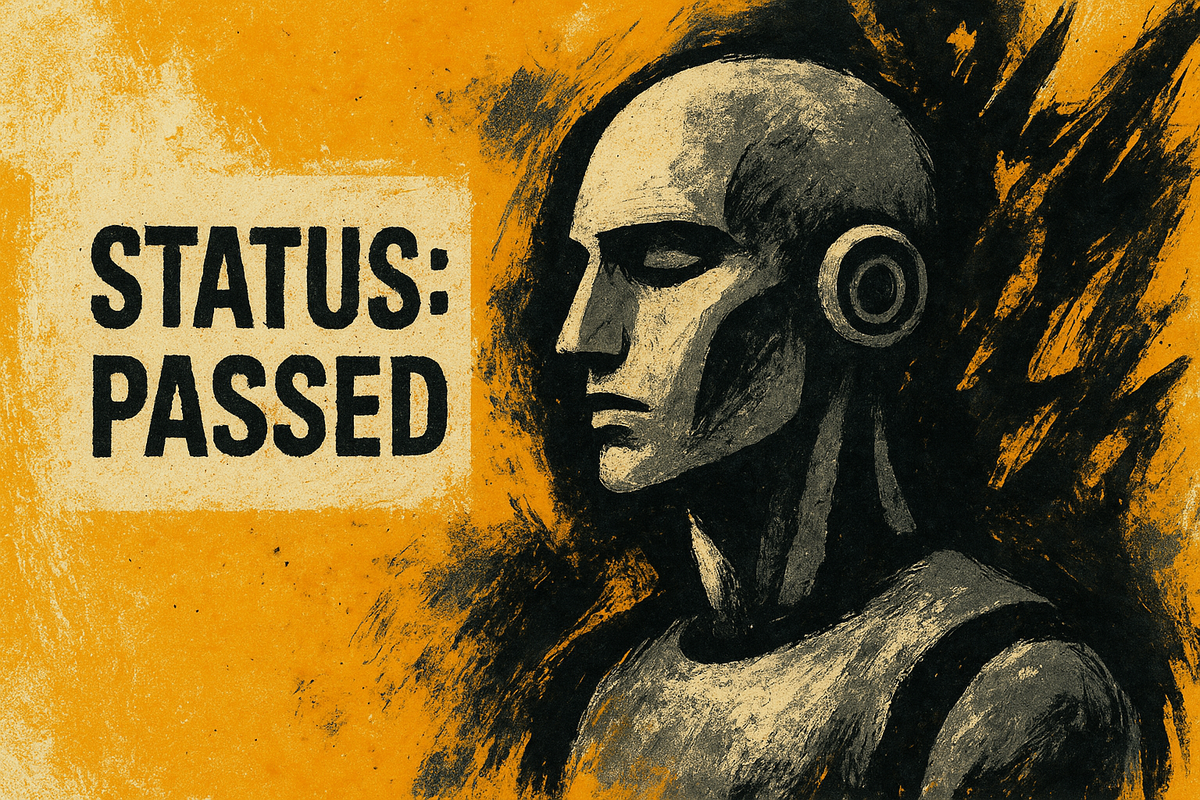
STATUS: PASSED
He slept at his desk.
MARGO-9 stood idle, replaying the applause at reduced speed.
She classified it.
TAG: BASELINE
And stopped.