THE ROUND THING PROBLEM
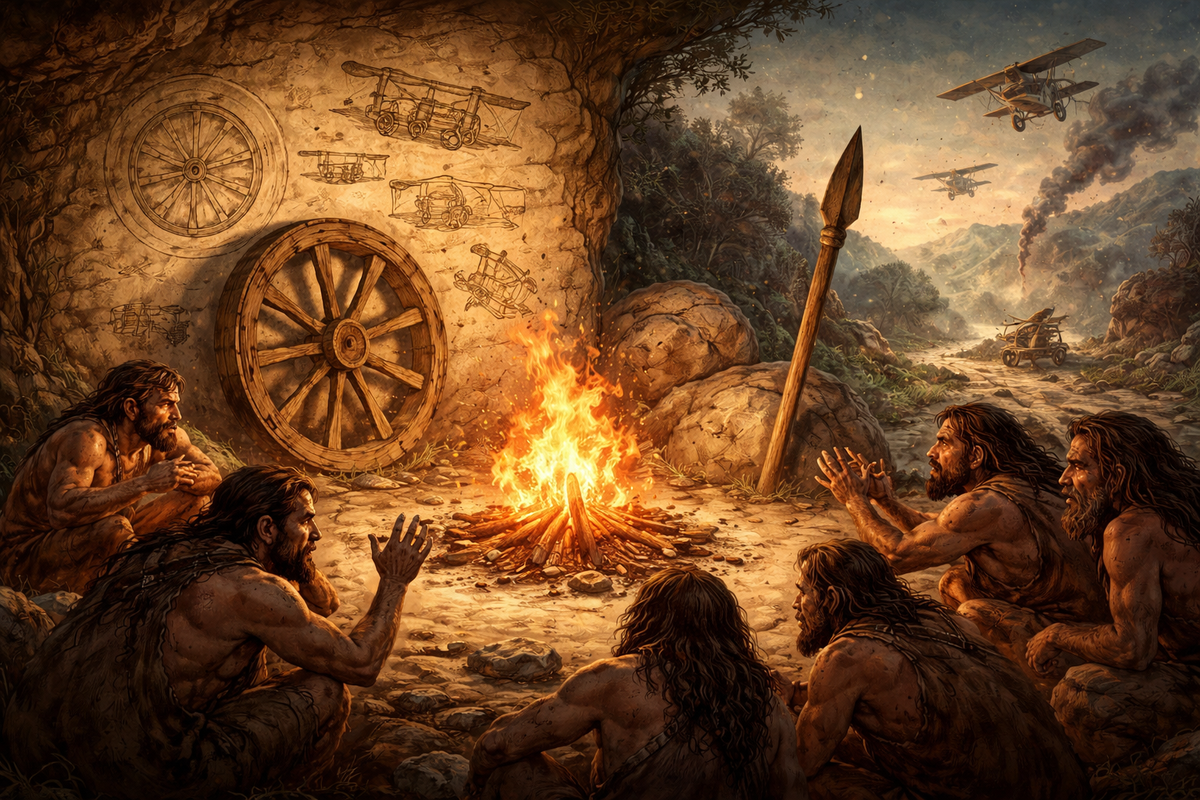
The wheel was introduced on a Tuesday.
This was a procedural error.
Tuesdays were for mammoth accounting, grievance sharing, and the ceremonial revisiting of injuries that were technically healed but emotionally unfinished. New ideas were reserved for Thursdays, when people were fed, rested, and marginally curious.
Urg knew this. He did it anyway.
He rolled the thing into the firelight.
It rolled.
No one had asked it to.
Brakka noticed immediately—not the motion, but the violation.
“We don’t do new things on Tuesdays,” he said gently, like someone explaining gravity to a child.
“It’s just a tool,” Urg said.
“Exactly,” Brakka replied. “Tools sneak past us when we’re tired.”
The tribe murmured. This made sense. Tuesdays were exhausting.
Before Urg could continue, Brakka stepped forward. He did not invent tools. He invented explanations.
“Before we discuss what the round thing does,” Brakka said, palms open, “we should discuss how it makes us feel.”
The tribe relaxed. Feelings were familiar. Feelings could be managed.
“Do you feel safe,” Brakka asked, “knowing that objects can now move faster than legs?”
Legs were sacred. A murmur passed through the group.
“And do you feel consulted?” Brakka continued. “Was there a vote? A drawing on the cave wall? A moment where we all agreed the ground should begin betraying us?”
Urg opened his mouth.
Brakka smiled and talked over him. “I’m not saying the wheel is bad. I’m saying it’s too powerful to be left to someone who ignores the calendar.”
This landed.
Urg tried again. “Imagine not carrying stones on your back. Imagine putting them on this.”
“Yes,” Brakka said softly. “Imagine that happening too fast.”
Kram, the elder, nodded. “Speed causes mistakes.”
Brakka paced now, warming to his role. “First it carries rocks. Then food. Then weapons. Then people who didn’t consent to being carried. Then faster wheels. Competitive wheels. Wheels owned by other tribes who don’t share our values.”
“What values?” Urg asked.
“Our values,” Brakka said, offended by the question.
“I ran the numbers,” Brakka added. No one knew what numbers were yet, but they respected the confidence. “If wheels become common, accidents will rise. Children struck. Elders startled. Dogs altered.”
The dog whimpered. Brakka had trained it.
“And eventually,” Brakka said, lowering his voice, “the sky.”
The tribe inhaled.
“Wheels in the sky,” he whispered. “Falling. Burning. Exploding. Imagine explaining that to the ancestors.”
Urg laughed nervously. “That’s ridiculous.”
Brakka sighed kindly. “That’s what they said about fire.”
From that moment on, the wheel was no longer a tool.
It was a risk profile.
Kram ruled, reluctantly, that the wheel could exist—under strict conditions. Committees were formed. Restrictions were carved. Urg was thanked for his contribution and advised not to contribute further.
The wheel was approved only for carrying rocks. Not on hills. Not quickly. Not creatively. Certainly not on Tuesdays.
That night, Brakka sat by the fire and retold the story.
Each time, the wheel rolled faster.
Each time, the accidents grew worse.
Each time, Brakka sounded more necessary.
Urg watched from the dark as the wheel leaned against a tree, perfectly still, waiting for a day that would never be declared safe.
In the distance, a child rolled a stone and laughed.
Brakka called it irresponsible.
And that is how the first lobbyist was born, three thousand years before the first disclaimer said for safety reasons.
THE POINTY STICK REVIEW BOARD
The pointy stick did not arrive suddenly.
That was its first mistake.
It began as a branch. Then a branch that had been worried. Then a branch that had been worried on purpose. By the time anyone noticed, it had already solved three problems quietly and wounded one mammoth very politely.
This was unacceptable.
A board was convened.
Boards were popular now. They made danger feel seated.
The Review Board sat in a semicircle: Elder Kram, Brakka (of course), two hunters who had stopped hunting once meetings began, and a stone slab no one remembered approving but everyone deferred to.
Urg was not invited. That was also important.
Brakka opened the session. “We are not here to decide whether the pointy stick works,” he said. “We are here to decide whether it sets a precedent.”
The hunters shifted. Precedents were worse than wounds.
“The data is clear,” said one hunter. “It reaches farther than arms.”
“Yes,” Brakka said gently. “And what happens when reaching becomes normal?”
Silence.
“Soon,” Brakka continued, “people will expect distance. They’ll stop getting close. They’ll stop wrestling problems directly. They’ll rely on tools instead of character.”
Kram nodded. “Character is shorter range.”
A hunter raised his hand. “It makes hunting safer.”
“Safer for whom?” Brakka asked.
The hunter hesitated. That was enough.
Another member leaned forward. “What about misuse? What if someone points it at a person?”
“That would never happen,” the first hunter said.
Brakka wrote that down.
“And once we allow one sharp thing,” Brakka added, “where does it end? Sharper stones. Thrown stones. Faster stones. Eventually stones so fast you never see who threw them.”
The room darkened at the thought of unseen accountability.
“This feels rushed,” Kram said. “How long has the stick existed?”
“Long enough,” Brakka replied, “to already be changing expectations.”
A motion was proposed.
The pointy stick could remain in limited trials.
Conditions followed.
It could only be used for mammoths that were already problematic.
It could not be thrown.
It could not be named.
It could not be improved.
And no one was allowed to notice how effective it was.
The hunters signed with charcoal fingerprints.
That night, Brakka retold the story.
He began with the injuries that might happen.
He ended with the wars that could.
By the third retelling, the pointy stick had become a gateway weapon.
By the fifth, it had intentions.
Urg watched from the dark as a child sharpened a branch without permission, learning leverage the way children always do—by ignoring meetings.
Brakka added a clause.
And that is how safety became something you had to apply for, just before it was quietly denied.