THE LUCKIEST HARD TIME IN HISTORY
How Technology Made Life Better, Broke a Few Things, and What We Refuse to Lose
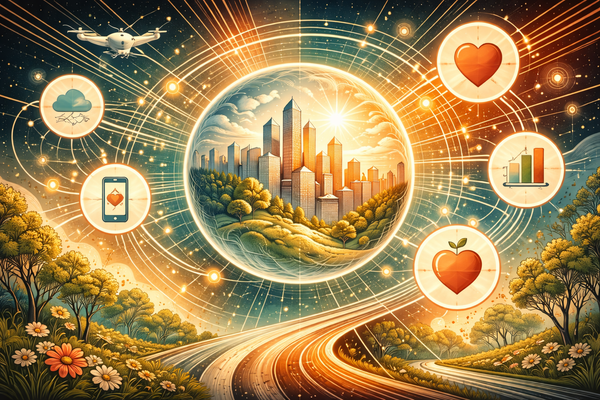
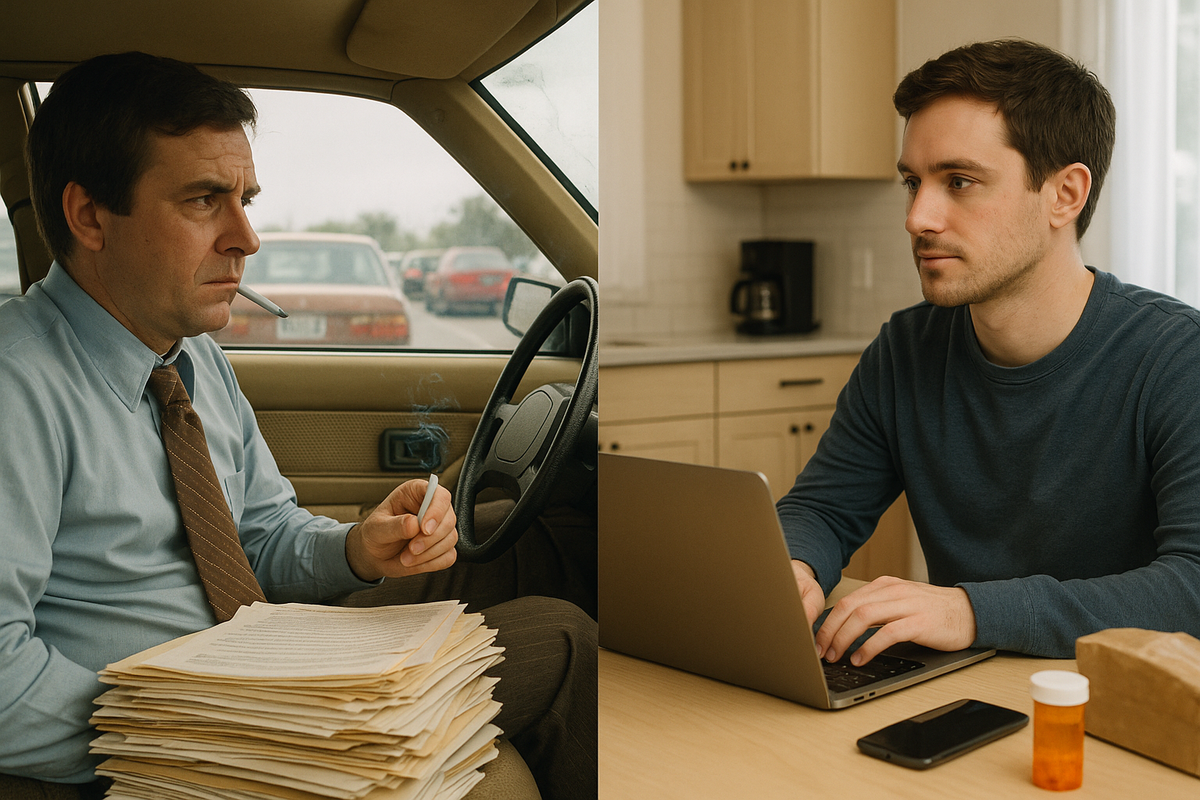
Human life looks like a split-screen now.
On one side: 1985. A worker in a polyester tie inching down Highway 41, talk radio fuzzing through the dash. Paper forms stacked on every flat surface. Smoke breaks. Long-distance charges. A doctor who doesn’t have imaging and must guess more than anyone is comfortable with. The world moves at fifteen miles an hour, and so does the news.
On the other side: 2025. That same worker—maybe their kid—sitting at a kitchen table with a laptop capable of running models that used to require a university lab. Groceries arrive in hours. Bills pay themselves. Even in Fresno, a family with an average income can access antibiotics, global communication, high-quality entertainment, real-time maps, and a phone with more processing power than the computers that carried astronauts to the Moon.
Split-screen progress. Split-screen exhaustion.
Materially, we’ve never been safer or more capable. Psychologically, the floor keeps tilting under our feet. Everything moves too fast, too loud, too public. The world is a better place to live and a worse place to think. And the dissonance is driving people into nostalgia, nihilism, or some new flavor of techno-apocalyptic panic.
This isn’t a eulogy for the old world. It’s a ledger. What got better, what got strange, and what we absolutely refuse to lose as we build whatever comes next.
1. The Quiet Miracles We Stopped Noticing
Strip away the noise for a moment. Look at the brute facts:
Work doesn’t kill us the way it used to.
Across the last century, workplace deaths in the U.S. dropped by more than 90%. Mines got sensors. Construction got harnesses. Factories got guards, rails, protocols—plus automation taking on the jobs that used to take people’s limbs or lungs in their twenties.
Time got cheaper.
You don’t stand in line to cash a check. You don’t call hospitals for lab results. You don’t wander a store wondering if the part exists; your phone knows. The household bureaucracy that used to devour two evenings a week collapses into a handful of taps.
Knowledge democratized.
A teenager in Selma can learn Python on a cracked iPhone. A vet clinic can run diagnostics that once lived only in universities. Parents Google symptoms at 2 a.m. (sometimes for better, sometimes for worse) because medical information escaped the library and took up residence in our pockets.
Medicine became a force multiplier on life.
A century ago, an infection could end you. Today, most kids in developed countries survive nearly every disease that would have wiped out entire families in 1900. Vaccines, imaging, cardiac interventions—every one a quiet miracle.
Tools got leverage.
A solo founder spins up compute clusters in minutes. A creator in a Fresno apartment publishes to millions. Ideas don’t need institutional blessing anymore; they need bandwidth and nerve.
None of this is sentimental. None of it is fake.
This is baseline reality: we won a million small upgrades that reshaped the human condition.
2. The Upgrades Came With Weird Costs
Progress isn’t free. It comes with side effects nobody voted on.
The Speed Trap
Systems that used to move at the pace of paper now move at the pace of electrons.
Bank runs begin in group chats. Misinformation outraces correction. You can destroy a reputation or move a stock price before breakfast. Infrastructure—political, educational, legal—can’t keep up. Slow systems carrying fast information behave like old machines pushed past their rated capacity. They shake. They overheat. They fail.
The Perception Collapse
We don’t live in our own senses anymore.
We live in the feed and its distortions.
We see our lives as metrics: steps, views, likes, productivity dashboards.
We see the world as a parade of worst-case scenarios algorithmically curated to keep us watching.
The brain isn’t built for omniscience. It treats every piece of news as a personal threat. It can’t tell the difference between a distant crisis and one outside your front door. Anxiety follows naturally.
Inequality Gets a Megaphone
The gap between “fine” and “thriving” grows wider and louder.
The wealthy use technology like a compound interest machine: better education, better tools, better access.
Everyone else gets gig platforms, financial precarity, and performance-managed by software.
The ladder didn’t disappear—it just got greased.
Attention Becomes a Battleground
You’re not lazy. You’re overloaded.
Platforms make money by hijacking attention. Notification by notification, your mind becomes contested terrain.
Physical labor went down. Cognitive labor went up.
Humans weren’t built for a world where every idle second becomes another invitation to keep consuming.
Progress is real, and so is the psychic toll.
3. Crisis Becomes Content
There was a time when news was a nightly interruption. Now it’s an intravenous drip.
Algorithms Don’t Just Show Reality—They Distort It
The worst 1% of human behavior—violence, corruption, idiocy—gets amplified until it looks like the norm. A steady stream of exceptions masquerading as the rule.
If you consume enough of it, you’ll start believing the world is collapsing in every direction.
Tech Hype Oscillates Between Utopian and Apocalyptic
Crypto will save us.
Crypto will doom us.
AI will free us.
AI will enslave us.
The pattern repeats. Overshoot, backlash, hangover.
Under the noise, real improvements accumulate: boring compute, invisible infrastructure, quiet breakthroughs.
But the public never sees the middle. Only the extremes.
Permanent Emergency Mode
When every day feels like a crisis, nothing feels solvable.
People lose the ability to prioritize. To think long-term. To invest in local reality.
Constant doomscrolling isn’t awareness. It’s paralysis disguised as vigilance.
4. Remembering How We Lived Before the Feed
Not to rewrite history—most of the past was worse—but to understand the value of the constraints we lost.
Work Before the Cloud
You went to work, then you left work.
You couldn’t be reached at the grocery store, in the yard, during dinner.
Your day had edges.
Your attention wasn’t fractalized across a dozen apps.
Community Before Digital Life
You knew your neighbors.
You knew the people at church, the clinic, the school, the club.
Reputation didn’t travel at light speed, and so you had time to repair mistakes instead of being cemented into a feed-snapshot forever.
Boredom as a Mental Cleansing Agent
Lines, waiting rooms, commutes—all forced your mind into idle wandering.
Those empty spaces made creativity possible.
Now they’re filled, sealed, monetized.
Limits Were Protective
Phone lines got busy.
Stores closed.
TV had a schedule.
The world had a shape. It was impossible to drown in infinity.
We lost friction. We gained overstimulation.
5. What We Refuse to Lose
We’re not going back. We shouldn’t.
But some things are non-negotiable if we want to stay human in the middle of all this power.
Human-Scale Relationships
Strong ties over loud ties.
A handful of people who care more about your life than your opinions.
Clinics rooted in a community. Neighborhoods that matter. Families you can count on.
Boundaries and Off-Switches
Hard edges in a soft world:
No-notification windows.
Tech-free spaces.
Daily shutdown rituals.
Organizations that enforce sane expectations instead of offering wellness webinars.
Craft Over Optimization
The pursuit of mastery.
Time to learn deeply instead of duct-taping solutions for speed.
A refusal to turn every task into a race.
Local Reality as Primary Reality
Your city matters more than the feed.
Your neighbors matter more than distant strangers.
Your problems are solvable if they stay local long enough to be seen clearly.
The future is built by people anchored in the real world, not drifting in the outrage economy.
6. Gratitude Without Delusion
Gratitude is not denial.
It’s calibration.
We’re the first generation whose material conditions outperform the wildest dreams of our great-grandparents—and we’re also the first generation forced to process global chaos in real time.
Both things are true.
The world is better than it feels.
Our minds are more fragile than we admit.
The right posture is simple:
Thankful, but not tranquilized.
Grateful for the progress.
Unblinded by the costs.
Committed to protecting the parts of life that no upgrade should replace.
Human life in 2025 sits at a strange crossroad:
the most advanced moment in history paired with the most disorienting information environment ever built.
If we can hold our bearings—keep the gains, repair the damage, fortify the human-scale fundamentals—this era becomes not a storm to outlast, but a foundation to build on.
We are living through the luckiest hard time in history.
The challenge now is making sure it becomes one worth remembering.