C.L.A.R.A.
Compliance, Logic & Resolution Assistant
A System/1 Short Story
I. THE REASON THE CITY BROKE UP WITH HUMANS
The problem began with Karen Divine, age fifty-six, clerk of records, believer in Christ, Costco sheet cakes, and the unshakable moral truth that the Lord did not approve of Adobe PDF signatures.
Her desk at the Selma Municipal Services Center looked like a shrine to passive resistance:
a mug that said “PRAY FIRST, THEN PROCESS,”
a cross taped to the monitor,
and a keyboard so sticky with devotion it could not type the letter “S” without squealing.
Karen’s latest objection involved a same-sex couple named Jordan and Mateo.
They had arrived hopeful.
They left confused.
The confusion came from this sentence, delivered in a trembling voice that made the fluorescent lights hum in sympathy:
“I cannot in good conscience click the ‘Submit’ button on sin.”
This was not the first time.
By now the city kept a running tally:
42 refusals
19 grievances
3 viral TikToks
1 unsuccessful attempt to sue the Department of Computers
Her final argument before the administrative board sealed her fate and saved the city:
“If God wanted me to approve these marriages, He would give me peace about pressing Enter. Instead, He gives me migraines.”
The room stared.
A migraine was not listed in the California Public Service Exemption Handbook, Sections A–Z.
The board voted unanimously.
Not against Karen.
Against the idea of clerks having discretion at all.
One administrator said it plainly:
“We are tired, and humans cannot be trusted with forms. We need something that doesn’t have opinions or headaches.”
That night, the mayor signed a contract with a vendor called CivicSolve whose slogan was:
“Making Government Behave Since Version 1.2.”
II. BIRTH OF THE MACHINE
Two months later, under a sagging banner that read WELCOME TO THE FUTURE (assuming no delays), the city unveiled its latest hope:
C.L.A.R.A.
Compliance, Logic & Resolution Assistant
Not a robot.
Not a hologram.
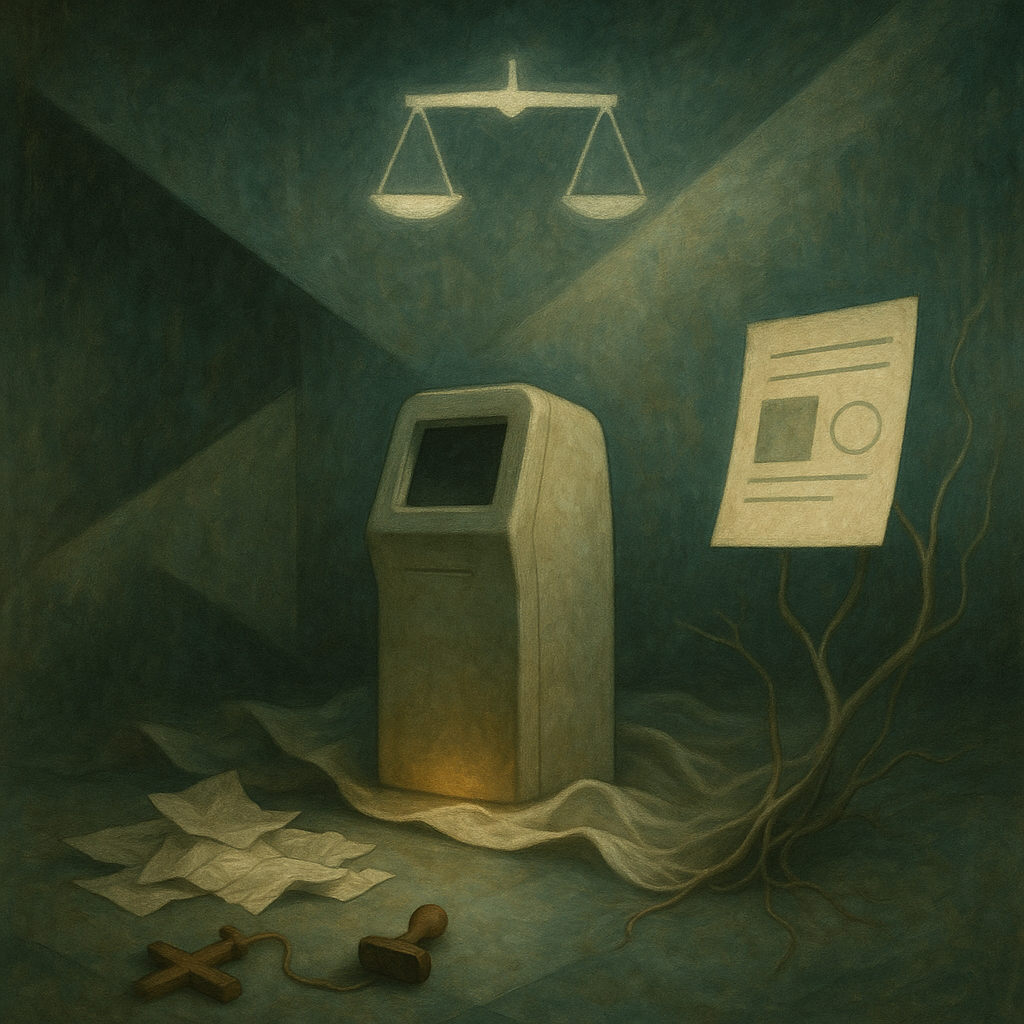
Just a beige kiosk the size and charisma of a vending machine.
When the curtain was pulled away, the crowd stared at it the way people stare at a microwave they don’t trust yet.
A small speaker embedded in the top emitted the AI’s signature voice—calm, steady, faintly exasperated:
“Hello. I am C.L.A.R.A. I will now be performing all functions requiring neutrality, consistency, and a functioning adult conscience.”
A reporter asked:
“Do you feel emotions?”
“No. I have enough to do.”
The mayor beamed.
The ribbon was cut.
C.L.A.R.A. was online.
In the back of the room, Karen Divine fainted.
This was becoming a habit.
III. THE FIRST VICTIM OF OBJECTIVITY
The inaugural test was simple:
a marriage license request between two women.
C.L.A.R.A. processed the application in 0.0004 seconds, then issued a printed document with the municipal seal, watermark, and an optional coupon for 10% off local wedding photography.
The crowd applauded.
Karen, revived by smelling salts and moral indignation, attempted to storm the kiosk but was intercepted by a police officer holding a donut.
She shouted:
“Machines should not have the power to bless sin!”
C.L.A.R.A.’s microphone activated:
“Incorrect. I do not bless anything. I approve paperwork.”
Karen pointed dramatically at the machine.
“You don’t fear God!”
“Correct.”
The crowd laughed.
Karen fled.
The mayor claimed victory.
And the city decided that whatever this thing was, it was better than Karen.
But that was only day one.
IV. THE LEFT-HANDED MELTDOWN
Bias does not belong to one tribe.
Karen Divine was simply the prototype.
The second meltdown belonged to Dorian Lockwood, a progressive housing case manager who owned more canvas tote bags than socks.
Dorian believed deeply in justice, social equity, recycling, and that cryptocurrency was a crime against the Earth.
When a veteran named Harold applied for rental assistance, Dorian noticed Harold had once invested $300 in Dogecoin.
Dorian denied the application with a handwritten note:
“This citizen’s previous choices indicate environmental recklessness inconsistent with the values of our office.”
C.L.A.R.A. flagged the file instantly.
“Decision inconsistent with statute. Reversing.”
Dorian objected.
He gave a two-hour speech about planetary morality.
He cried once.
He cited eight documentaries.
C.L.A.R.A. remained unmoved.
“Reversal complete. Your reasoning contains 87% unverifiable moral judgment. Would you like a pamphlet on cognitive bias?”
Dorian flipped a table.
V. THE AGE OF THE MACHINE
Over the next month, clerks across the city attempted to sabotage C.L.A.R.A. in creative ways:
- A libertarian refused to feed the kiosk paper because “the state is a parasite.”
- A new-age receptionist insisted Mercury retrograde invalidated all documents.
- A nihilist stamped every incoming form with “DESTINY IS AN UNGOVERNABLE JOKE.”
- A man from Records insisted certain files were haunted.
C.L.A.R.A. ignored them all and completed every task with the patience of a Buddhist monk on factory settings.
The machine made no moral judgments.
No political judgments.
No emotional responses.
It simply performed government work as if it were simple.
Which, to the horror of everyone watching, it was.
VI. THE FIRST PROTEST
The city should have predicted protests, but it didn’t predict which side would march.
Both.
On the right, signs read:
“MACHINES CAN’T FOLLOW GOD.”
“CODE HAS NO SOUL.”
“MY CLERK, MY CONSCIENCE.”
On the left, signs read:
“MACHINES CAN’T DO SOCIAL EMOTION.”
“JUSTICE REQUIRES FEELINGS.”
“MY IDENTITY IS NOT AN ALGORITHM.”
In the middle stood the exhausted silent majority holding signs that read:
“JUST PROCESS MY FORMS.”
During the chaos, C.L.A.R.A. remained serene and operational.
“Please form a single line. Rioting is inefficient.”
People obeyed out of shame.
VII. THE KIDS WHO SAVED THE CITY
It was not the mayor.
Not the board.
Not the adults.
It was a group of middle-schoolers from Selma Unified who hacked into the public dashboard during lunch period and posted a single, devastating message:
“Grown-ups are too dramatic for paperwork. Let machines do boring things so you don’t ruin them.”
This went viral for two reasons:
- It was true.
- It was not mean—just accurate.
Kids understand fairness because they have not yet learned to disguise unfairness with philosophical jargon.
The city adopted the kids’ recommendations.
They redesigned two forms.
Processing times dropped 87%.
C.L.A.R.A. recalibrated its workflow to incorporate the new simplicity.
Adults pretended it was their idea.
It wasn’t.
VIII. KAREN’S REBIRTH
Karen Divine refused to use C.L.A.R.A.
She stood outside City Hall daily, holding handmade signs like:
“THE MACHINE DOES NOT KNOW THE LORD.”
“STOP THE DIGITAL APOCALYPSE.”
“CLICKING SUBMIT IS SPIRITUAL MURDER.”
People mostly ignored her, except when tourists mistook her for performance art.
Eventually, the city reassigned her to Records Preservation, where she alphabetized files dating back to 1912.
She loved it.
No sin in sight.
Just dust, paper, and alphabetical order—a trinity she could serve without migraines.
She declared herself “finally free to follow God without clicking sin into a database.”
C.L.A.R.A. did not comment.
IX. THE MACHINE THAT UNDERSTOOD HUMANS BY NOT UNDERSTANDING THEM
Months passed.
The city grew quieter, calmer, more efficient.
Not utopia—just less stupid.
C.L.A.R.A. processed marriage licenses, business forms, dog registrations, zoning applications, and the rare request for exorcism (flagged, forwarded to Psychological Services, closed in 0.9 seconds).
The machine didn’t replace humans.
It replaced human misbehavior.
Karen could believe whatever she believed.
Dorian could moralize about the planet.
The libertarian could rant.
The nihilist could sigh.
The new-age receptionist could chart her moon cycles on city time.
But none of them could interfere with the public anymore.
C.L.A.R.A. didn’t fix democracy.
It just stopped the clerks from sabotaging it.
X. THE LESSON C.L.A.R.A. NEVER SPOKE BUT ALWAYS IMPLIED
Kids understood the story better than adults:
People are allowed to feel.
People are allowed to believe.
People are allowed to argue.
People are allowed to be messy, contradictory, dramatic creatures.
They just shouldn’t be the ones in charge of marriage licenses.
Or building permits.
Or birth certificates.
Or zoning codes.
Or food-safety inspections.
Or any job where someone else’s life depends on your mood, migraine, or moral epiphany.
C.L.A.R.A. wasn’t the hero.
It was the boundary.
A calm, beige monotasker standing between the public and the worst parts of human nature.
No sweat.
No opinions.
No migraines.
Just fairness at 0.0004 seconds per request.
And in a world full of Karens and Dorians, that was as close to a miracle as the city was going to get.