AUDIENCE NOT FOUND
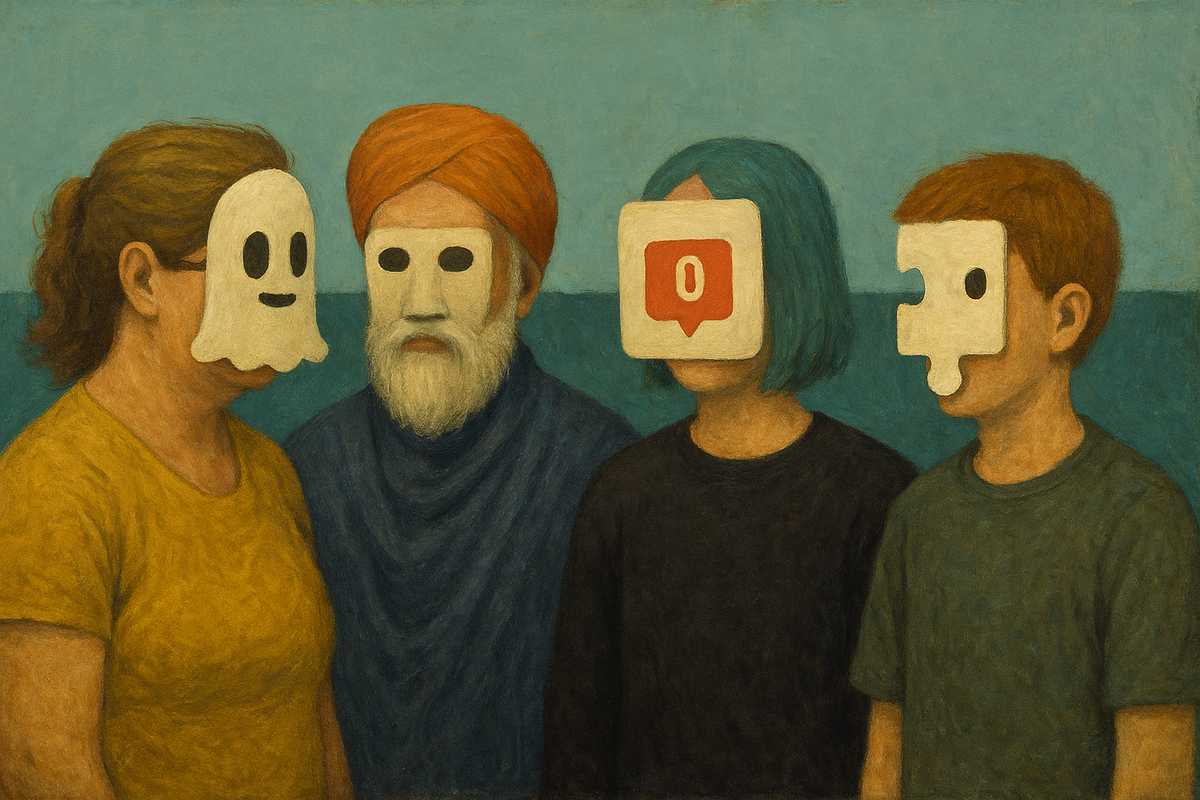
The expo smelled like melting carpet and ambition. Providence had converted an old hockey arena into a “Climate, Culture, and Emotional Infrastructure Showcase,” which meant the sponsors were startups with names like Empathix, HeartWare, and FeelGrid—firms determined to algorithmically map the parts of human life they least understood.
The “Cultural Empathy Dome” was the centerpiece. A smooth white hemisphere the size of a small planetarium, humming with LED anxiety. A sign announced:
IMMERSIVE CROSS-CULTURAL UNDERSTANDING
(IN BETA — PLEASE FORGIVE HICCUPS)
Everyone forgave nothing. They were just bored enough to try it.
The first to enter was a Boston woman built from Dunkin’ runs and late-night arguments. Big shoulders, big voice, bigger suspicion. She wore defiance like jewelry. Her name was Maureen, though the badge printer misread it as Mawreen, which she took personally.
Next came the older man from Kathmandu. His badge read Suman: Wisdom Liaison, a title he did not supply. He noticed immediately the dome had been designed by someone who’d never left Palo Alto but believed “global” meant adding prayer-bell samples to UI sounds.
Behind him drifted a Gen Z influencer—pink hair, tactical authenticity, ring light dangling from a lanyard. They filmed everything except the things that mattered. A dead zone killed their stream, so they started narrating out loud, performing for ghosts.
Trailing them was a skinny Irish kid who followed patterns instead of directions. His hair stuck up like static. His name was Eoin, though the volunteer wrote it down as Owen, and he didn’t correct her. Corrections exhausted him.
Four strangers, each silently convinced they already understood the others.
The dome door closed behind them with a hiss that felt intentional.
I. The Machine Decides Who They Are
The chamber glowed awake—holograms blooming like mold under a blacklight. A corporate voice purred:
WELCOME. INITIATING EMPATHY CALIBRATION. PLEASE MAINTAIN YOUR NATURAL SELVES.
All four stiffened, because nothing kills natural behavior faster than being asked for it.
The system scanned them with tonal confidence only bad algorithms know.
It labeled Maureen: AGGRESSIVE CARETAKER ARCHETYPE.
Suman: SERENE SAGE MODEL.
The influencer: AUTHENTIC YOUTH AMBASSADOR.
Eoin: NO MATCH.
No-match status unsettled the machine. It flickered.
Then the projections began.
For Maureen, the dome generated a floating Greek chorus chanting her assumed thoughts in thick accents.
“She’s sizing them up.”
“She thinks she’s in charge.”
“She’s ready to fight the room.”
She wasn’t. But she almost did after hearing that.
For Suman, a holographic avatar appeared—robes, staff, voice pitched one octave holier than human.
“Share your gentle wisdom,” it instructed.
He stared at it like someone sizing up an appliance they might legally be allowed to dismantle.
The influencer’s follower count materialized in the air. Every time they exaggerated—or tried to smooth tension with a brand-safe joke—the number plummeted.
They panicked. They doubled down. It dropped harder. The dome seemed disappointed.
Eoin stood untouched. No role. No projection. Just a kid in the middle of everyone’s forced theater, watching them as if examining a glitch in a video game.
“You’re all doing silly voices,” he finally said.
No one argued.
II. Cracks in the Wrong Places
The dome ran scenario after scenario—bad simulations stitched from stereotypes, tourism ads, and half-digested anthropology papers.
A hologram of “Boston Street Tough with Heart of Gold” kept following Maureen around asking her to “guide the group.”
She tried ignoring it. It grew louder.
Eventually she snapped:
“Lady, I don’t even guide my own life. Get lost.”
The avatar vanished with a hurt beep.
Across the dome, the mystic projection kept lecturing Suman on breathing techniques he’d never heard of.
He finally barked at it:
“I’m an engineer, you absolute tin joke. Stop pretending I float.”
The avatar attempted to float higher in retaliation.
The influencer tried grounding everyone with a motivational speech for the camera that wasn’t recording:
“We’re all experiencing this together and that’s powerful—”
Their follower counter dropped to zero.
They slumped like someone unplugged.
Eoin walked the perimeter, tapping the walls, humming.
“I think it’s stuck in a loop,” he said.
“A loop of what?” Maureen asked.
“Misunderstanding,” he answered, like it was obvious.
The dome flickered violently at the word.
III. When Performance Stops Working
Suman was the first to give up pretending.
“I’m not your sage. I hate meditation. I build drainage models,” he muttered, prying open a panel with surprising force.
His honesty made the machine stutter.
One projection crashed like a frozen app.
The influencer, terrified of their vanishing metrics, whispered, “I don’t know who to be without an audience.”
This time, the follower counter didn’t fall. It froze—confused.
Maureen paced, breathing hard, until she admitted,
“I don’t know how any of this works. I can’t think in holograms.”
“Finally,” Suman said, relieved.
Eoin, hearing that, finally relaxed.
“I can help,” he said. “But you have to stop being loud in weird ways.”
This was the closest thing to a truce the dome ever witnessed.
Together they mapped the malfunction:
• The dome was originally built to predict crowd evacuations.
• The empathy upgrade was cosmetic.
• The identity models weren’t deep—they were shallow shortcuts fed into a fragile system.
“We weren’t misread,” Suman said.
“We were rounded.”
The machine glitched violently at that.
IV. Improvised Escape
They coordinated:
Maureen cleared a path through the projections—parting holograms like someone fighting fog.
Suman rewired an exposed access panel, muttering curses that did not sound sage-like.
The influencer deliberately fed the dome emotional contradictions—fear, delight, boredom, gratitude—scrambled signals that tanked the machine’s labeling engine.
Eoin found the repeating movement pattern behind the projections—an old evacuation algorithm firing wrong.
“There,” he said, pointing to a pulsing seam of light. “That’s the exit if we walk like a crowd instead of four people.”
They followed him.
The dome dissolved around them like a collapsing stage set.
They stepped into the maintenance corridor.
The door behind them shuddered and sealed.
V. The Five-Minute Window Without Masks
The hockey arena was empty, echoing, cold.
No projections. No expectations.
No algorithm forcing meaning into the air.
They stood there—four incompatible strangers with nothing left to perform.
“You’re all quieter out here,” Eoin said.
Not judgment. Observation.
They didn’t respond. They didn’t need to.
Then the world resumed:
The influencer’s phone reconnected—buzzing with notifications like an impatient boss.
A staffer yelled about malfunction reports.
A tourist asked Suman for “the robe thing,” which he refused on principle.
Maureen lit a cigarette like she was clocking back into herself.
Masks slid back on—crooked this time, fractured at the edges.
They didn’t exchange names or numbers.
They split off into separate directions, each carrying an uncomfortable truth:
For a few minutes, with no audience, they were real.
And the dome wasn’t the only thing that glitched.