AN1MAL SP1R1TS
Human irrationality was always dangerous. Quantifying it was worse.
__
The Sentiment Map looked calm enough to medicate a continent.
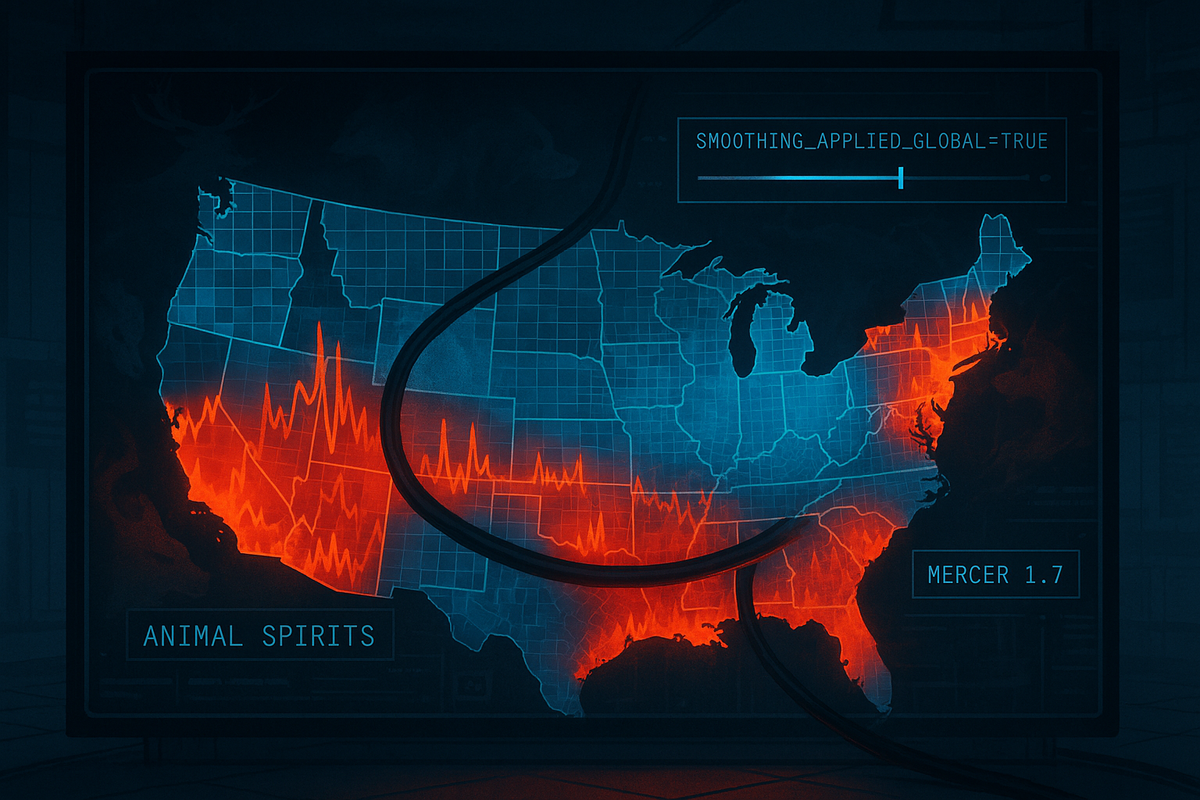
Fifty states, thousands of cities, all tiled across the wall-size display. Each block pulsed in slow gradients tied to eight indices: anger, fear, calm, anticipation, fatigue, cohesion, tribalization, volatility. The colors sat in the middle bands—more blue than red, more tired than furious. The kind of emotional weather that made anchors use words like “stability” and “resilience” and then check their phones under the desk.
Steve Mercer didn’t feel stable.
He sat alone in the half-lit Emotion Dynamics Lab, locked on a cluster of tiles in the Midwest. Five mid-sized cities across three states. Their anger curves were identical.
Not similar. Not “same shape, different noise.”
Identical.
He pulled the last twenty-four hours and overlaid the lines. Same rise at 08:13. Same plateau. Same clean drop at 14:00. Same micro-spike at 19:42. Same neat taper into night.
Human behavior didn’t sync like that at population scale. Not without a metronome.
“Is someone smoothing regional data?” he asked, eyes still on the graph.
Behind him: keyboard clatter, low chatter, the hum of expensive climate control. The Lab’s floor was half nonprofit, half contractor—people who turned text, clicks, watch time, search terms, retail microtrends into numbers you could plot, invoice, and weaponize.
Nobody answered.
“Anyone smoothing?” he repeated, louder.
Near the coffee machine, someone said, “Probably just interpolation being weird.”
Laughter. Then the room put its headphones back on.
Steve copied the curves into a private folder and stamped a label: MIDWEST_SYNCH_01. He knew how this went when you pushed too hard. Someone would call it an ETL hiccup, a calibration issue, “just an artifact.” People here were very good at upgrading anomalies into trivia the second a client wasn’t asking about them.
He wasn’t built for that.
The last time he’d seen something this off, it had been a cluster of fringe accounts using the same phrases, same tempo, same outbound pattern. He’d logged it as an early-stage extremist network. His manager had said, “Correlation isn’t motive, Steve. File it and move on.”
Six months later, a “lone wolf” killed twelve people in a federal building. The manifesto used the same phrasing. Same tags. Same cluster pattern, scaled.
The post-incident review buried one line in an appendix: A junior analyst previously raised concerns about related account activity.
No credit. No blame. Just a sentence that translated to: someone saw this and we did nothing.
That line had taken up permanent residence between his shoulder blades.
If the numbers looked wrong, logging and moving on felt like malpractice.
He opened a shell, pulled raw logs for the five cities, and rebuilt the curves. Same outcome. Same smoothness between sample points. No jitter. No grain. It looked less like a measurement and more like a function.
Emotion wasn’t supposed to look like something you could differentiate.
He bookmarked the graph, added a note—check smoothing layer, regions MID-4 through MID-8—and tried to go back to his assigned work: tracking anger+fear combinations associated with organized offline action.
His gaze kept sliding back to the Midwest cluster. Five cities breathing in lockstep.
The Map said: nothing to see here.
His spine said: this is the cold open.
He stayed late.
The next anomaly arrived two days later, on schedule in a way that made him more nervous than randomness would have.
He was watching the Pacific Northwest tiles with a dull coffee and a worse sandwich. The main dashboard ticked on a thirty-second cadence, driven by batch jobs ingesting aggregates from platforms, search, streaming, and a handful of overpriced proprietary feeds.
At 13:11:30, fear in one Oregon region jumped twenty points and began climbing—a steep, clean rise. Anger barely twitched. Volatility ticked up, but not by much. It looked like someone had opened a localized anxiety valve.
At 13:14, an alert slid into a side panel: Industrial incident – Hillsboro. Small fire at semiconductor plant. Contained. Minimal injuries.
He rewound the sentiment feed. Fear had started climbing two minutes before the plant alert.
He checked timestamps. Verified sources. Cross-compared lags.
Fear first. Incident second.
Cause and effect, politely reversed.
He flagged the slice and ran a quick cross-source check. A few posts about smoke, alarms, sirens—enough to seed some local nerves. But the curve shape still felt off: too sharp, too coordinated against previous baselines.
Last year he might’ve shrugged and blamed data latency—internal alarms pushing out automated notices before public reporting. Stacked on the Midwest sync, it felt like pattern, not noise.
He dropped a screenshot into the Lab Slack.
STEVE:
Anyone seeing this pre-reactive spike in OR-3? Fear climbs before reported trigger.
Blinking cursors. Then a senior engineer:
DIYA:
Seen that before. Pipeline lag + pre-rumors. Event timestamps aren’t ground truth. Don’t over-interpret.
He typed, erased, retyped.
STEVE:
Curvature’s too clean. Also five-city sync in Midwest this week.
DIYA:
If it’s not breaking anything, it’s noise. We’re not building doomsday detectors.
Thumbs-up emoji. Shrug emoji. Thread closed.
On his screen, the fear spike laid over the extremist-network curve from years ago. Different domain, same rise time, same slope, same harmonic feel.
He saved it: PNW_PREREACT_02.
He should’ve gone home. He didn’t.
Instead, he opened a more privileged panel: internal logs for the Sentiment Map smoothing layer. Officially, the Lab only had partial visibility. The Map itself was run by a consortium: data brokers, platforms, a media analytics firm, and a civic-innovation non-profit that sold sanitized slices to governments. The Lab’s job was evaluation, not audit.
Unofficially, Steve had written enough glue code early on that he knew where the undocumented endpoints lived.
He pulled a week of smoothing events.
Sparse. A few obvious fixes, a handful of “test” overrides. Nothing that explained five cities snapping to one heartbeat.
Fine. So it was a slow burn.
He waited.
On Friday morning, the Map changed in a way even the wallpaper people noticed.
He walked in, set his coffee down, and stopped at the doorway.
The entire eastern seaboard was sliding from warm yellow into pale, washed-out blue. Anger and fear dropping. Calm and cohesion rising. Not jittery, not city by city. A single smooth wash rolling from north to south like someone was wiping down a screen.
Side monitors showed the usual mess—arguments, scandals, climate footage, standard civilization friction. No peace deals. No miracle bills. No sudden world-historical forgiveness.
The map was serene. The feeds were not.
As he watched, the central states followed, colors cooling, edges softening. It looked like someone had opened a massive emotional coolant loop.
“Okay, that’s not normal,” someone said in the back.
The Lab stirred. Headphones slipped off. People turned toward the wall. Rex, the director, stepped out of his glass box and frowned at the display.
“Anyone know what we’re looking at?” he asked.
Steve pulled up the smoothing logs. Timestamps were strobing. A series of OVERRIDE events, all within the last five minutes, all touching regional aggregates.
No operator IDs.
No patch hashes.
Just SMOOTHING_APPLIED_GLOBAL="TRUE" and parameters that read like “turn agitation down, turn calm up.”
His chest went tight.
Somebody had thrown a switch.
He waved Lena over. UX research. Officially here to “humanize outputs,” which meant she still talked to actual humans. One of the few people Steve trusted to reality-check his paranoia.
“Look,” he said.
She leaned in, scanning the logs, then glanced up at the wall.
“Smoothing-layer update,” she said. “Global patch, probably. Maybe a jitter fix. Maybe they pushed something meant for test into prod. Wouldn’t be the first time.”
“This doesn’t smell like a mistake,” Steve said. “Global flag. No operator. No documentation. That’s not an ‘oops.’”
“Or it’s exactly what ‘scrambling on a deadline’ looks like,” she said. “The Map’s been twitchy for weeks. Clients hate twitchy. They call it ‘instability’ even when it’s just humans being humans. Someone got tired of explaining variance.”
“Variance is the point,” he said. “If they’re smoothing at this scale, it’s not a mirror anymore. It’s a thermostat.”
“That’s a big leap off a few log lines.”
He pointed. “Unknown operator. Undisclosed patch. Global. That’s not hygiene. That’s policy.”
“Last time you made this speech, we barely knew which parts of the system were real,” she said. “You were right about the extremist cluster by accident and you’ve been chasing the feeling ever since. Don’t replay that arc.”
He didn’t answer.
The Map finished its wash and settled into a new baseline. On the news feeds, anchors started using phrases like “unexpected drop in public anxiety” and “rare moment of national calm.” Markets bumped a little and relaxed.
Rex said, “Let’s not overreact. Somebody reach out to the consortium. Assume bug until proven malice.”
Steve heard: assume nothing until it’s irreversible.
He screenshot the logs, exported them, dropped a new file into his private folder: QUIETING_GLOBAL_03.
Then he sat there and watched five cities breathe together, a country’s emotional contours ironed flat.
If this were a market story, the old economists would call it “animal spirits” being tamed. Confidence engineered. Panic capped.
The Map was supposed to be descriptive. Now it looked prescriptive.
He went home angry. He came back angrier. Then he mostly stopped going home.
The decision to leak wasn’t sudden. It was a stack: small rationalizations, one old wound, and a quiet belief that someone had to be the first idiot through the glass.
He spent the weekend scraping.
The Lab’s keys weren’t supposed to reach certain internal endpoints, but his old utilities—back when they were still duct-taping pipelines together—had never had their wings clipped. Technical debt, now pointed inward.
He pulled a week of smoothing events. Logged every OVERRIDE. Mapped them to shifts on the public Map.
The correlations were too clean. It wasn’t just error correction. It was surgical: protest spikes, panic waves, coordinated outrage—softened, trimmed, sometimes erased.
It could’ve been coincidence. It could’ve been someone protecting quarterly reports from “risk signals.”
It also looked a lot like a control surface.
He built graphs. Clean, un-dramatic, annotated. No conspiracy fonts. Drama got people ignored.
On Monday night he zipped the graphs and CSVs and dropped them into a mid-tier civic-tech forum that sat between governance-nerd Slack and tech Twitter.
New handle: NoiseFloor.
Short note:
These plots show undocumented smoothing on the national Sentiment Map. See especially the global quieting event Friday—no disclosed operator, no parameters. Either the system is dangerously broken, or someone is flattening emotional variance at scale.
Post.
Not a bomb. A slow leak.
A few people downloaded the pack. Some wrote thoughtful takes. Others screamed “mind control” and glued his plots to their preferred narratives. A mid-level influencer tagged it “The Calm Conspiracy.” Threads multiplied.
Within hours, the Map’s volatility ticked up.
Anger up. Fear up. Tribalization up.
Small but visible.
He checked the smoothing logs. New override events appeared in near real time. Someone was turning the dial further in response to the spike.
That tightness in his ribs again.
They were watching the watchers.
It didn’t feel like exposing something. It felt like poking a thermostat and watching it fight back.
The email from Malik landed once he’d already mentally quit his assigned job.
Subject: re: your anomaly pack
From: malik.vander@strategicfutures.consult
You’re not wrong. I’ve been watching this from another angle. If you want this seen in places that matter, we should talk.
No attachment. No manifesto. Just enough to trigger suspicion and hope.
He searched the name.
Malik Vander: political messaging, media analytics, “brand resilience.” Quoted in pieces about “narrative warfare.” Photos with people who show up at disinformation hearings and then vanish into consultancy.
Professional manipulator.
Exactly the kind of person you avoid if you want clean hands. Exactly the kind you meet if you’re tired of being the ignored footnote.
They met in a downtown coffee shop under the casual glare of cameras. Steve picked the spot on purpose. If you’re going to be recruited, do it in public.
Malik wore a quiet jacket, a quiet watch, and the expression of a man who enjoyed seeing farther than other people.
“I appreciate you coming,” Malik said. “Your post created a useful disturbance.”
“I wasn’t trying to create anything,” Steve said. “Just show what’s already there.”
“That’s how disturbances usually start.”
The amusement behind his eyes was measured, like everything else.
“What do you want?” Steve asked.
“To help,” Malik said. “You’re poking something bigger than you think. The Sentiment Map isn’t just a dashboard. It steers spend, message testing, field deployments. If somebody’s rewriting it upstream, everyone’s working off hallucinated mood.”
“We,” Steve said.
“People who care about reality,” Malik said, with a practiced half-smile. “Your data is real. Your patterns are real. Right now they’re just fuel for podcasts. If you can show systematic behavior—beyond one-off patches—I can move it into venues that don’t get to pretend they didn’t see it.”
“Media,” Steve said.
“Media. Committees. Internal saboteurs. The whole ecosystem.”
“And what’s in it for you?”
Malik shrugged. “What’s always in it for me. Leverage. It’s boring when the field is entirely rigged.”
Not a heroic answer. Honest enough.
Steve should’ve walked. He knew how this game went: you become someone’s evidence. But the idea of being right and ignored again felt worse than getting used.
“What do you need?” he asked.
“More than screenshots,” Malik said. “Logs. Configs. Anything that shows intent—especially around elections, protests, market nerves.”
“Fine,” Steve said.
It wasn’t fine. It was reckless, unethical, probably illegal.
He did it anyway.
Two weeks later, the Sentiment Map looked less like a mirror and more like a seizure.
His second leak, polished by Malik, hit three channels at once: the civic forum, a governance newsletter, and a blog run by a former SEC staffer who liked graphs more than people. The bundle tied smoothing events to big decisions: rate announcements, late-night policy drops, unity speeches that conveniently followed silence waves.
The headline people took away was simple: they’re managing moods.
Most of it was technically disputable. Correlation is cheap. But the smoothing metadata snapped everything into a story.
Anger spiked. Fear spiked. Mistrust soared.
“Emotional management” trended.
Campaigns rewrote talking points. Platforms tweaked feed rules. News desks booked “algorithm accountability” panels. Each reaction showed up on the Map. Volatility, once an interesting wobble, turned into a jagged skyline.
The consortium, staring at the same graphs, did the one thing large, scared organizations know how to do: protect optics.
Smoothing events multiplied. Quieting patches expanded from regional to national. Internal emails (which Steve didn’t see) used phrases like “reduce perceived instability” and “avoid panic feedback.”
He saw only the outputs: more artificial curves. More flat-topped anger waves. Blunted fear spikes.
He started naming them in his folders: SUPPRESS_PROTEST_12, COOL_MARKET_08, NEUTER_ANGER_05. The filenames hardened the story in his own head. Every intervention became malice.
In reality, small teams were throwing sand on every fire they could see, then logging off, exhausted.
The Map began to display weird negative spaces: bland calm where there should’ve been noise, entire metros sitting in “fine” while local feeds screamed. Policy decisions followed the Map, not the ground, and the mismatch fed more rage.
People yelling, “Why is nobody listening?”
The Map whispering, “They are. Just not to you.”
Feedback loop: outrage → spikes → smoothing → mistrust → outrage. A control system tuned by fear and PR.
Steve tracked it like weather. Slept on the Lab couch, lived on caffeine and old anger.
Lena stepped out of the blast radius. She rotated to projects with no levers attached.
Rex pulled him into the glass box once.
“I don’t know how much of this is you,” Rex said, “but stand down. We study systemic risk. We do not prototype it.”
“These curves were broken before I touched them,” Steve said.
“Maybe. Maybe not. Either way, you’re not the one to fix them.”
“What if I’m the only one trying?”
Rex looked at him for a long time. “If that’s true, we’re already screwed.”
Steve walked out and pulled more logs.
The failure point arrived on a Wednesday that didn’t deserve it.
No terror attack. No crash. No election night. Just the normal low thrum of a society in permanent almost-crisis.
He was watching a multi-region panel when a block of Midwest states went gray.
Not calm. Not neutral.
Null.
No curves. No data. Just a dead swath in the middle of the country.
He checked ingest jobs. Green. Platform status. All “operational.” Brokers. Nominal.
He queried the backend and got one line of error: REGION_VECTOR_NOT_FOUND.
The simple explanation was obvious: bug. Misconfigured shard. Index corruption. Boring failure.
The part of him wired by the previous months, and the old appendix line, supplied the other story: they’re blanking regions. Taking chunks of the country off the emotional grid.
He didn’t wait for engineering. No ticket. No Slack post.
He opened the old glue script—the one with overbroad privileges, written when “security” meant a TODO—and aimed it at the Map’s core model repository.
“Don’t,” Lena said from behind him.
He hadn’t heard her come in.
“Those regions just vanished,” he said. “If they’re erasing segments on purpose, we’re out of time.”
“It’s probably a schema screw-up,” she said. “If you hit the core with that skeleton key, you are going to break things for real people, not just lines on your monitor.”
“It’s already broken.”
“You don’t know that.”
He pointed at the gray block on the wall. “They made them invisible.”
“We don’t know who ‘they’ is. We don’t know what this is. You’re filling every gap with the worst possible story and then treating it as confirmed history.”
“Last time I waited for confirmation, twelve people died.”
“Last time you were right for reasons you still don’t fully understand,” she said. “You were lucky. You built an entire self-image around being ignored. Now you finally have an audience and you’re sprinting toward martyrdom because it feels truer than being careful.”
His face got hot. “You sound like the consortium.”
“I sound like someone who doesn’t want your paranoia turned into infrastructure,” she said. “Walk away, Steve.”
He turned back to the terminal.
“Can’t,” he said, and hit enter.
The script crawled the internals: configs, model weights, archived logs, smoothing parameters. It vacuumed the Map’s emotional brain and compressed it into a single swollen file.
He uploaded it to a public repo under a fresh anonymous handle and wrote one sentence:
This is the core of the Sentiment Map. You deserve to know how your mood is being quantified and controlled.
Send.
He texted the link to Malik.
Reply came back fast:
You just changed everything.
He’d meant to read that as victory. It landed like a charge sheet.
Emergency mode deployed over the next thirty-six hours.
First, the subtle stuff only people like him saw. The wall’s refresh interval slowed. Lines got unnaturally smooth even in low-interest regions. New log events appeared: EMERGENCY_STABILIZATION_ON, VOLATILITY_THROTTLE, HIGH_AROUSAL_SUPPRESSION.
Then came the public theater.
Platforms published synchronized policy updates about “temporary measures to reduce harm” after “unauthorized disclosure of sensitive model information.” Regulators held briefings about “maintaining order as emotional infrastructure is weaponized.” The words were familiar. The target wasn’t.
His dump, combined with the existing mistrust, had triggered exactly the conversation he thought he wanted—on terms he didn’t control.
People were furious. Not at any single actor, just at the idea that there was an “emotional infrastructure” at all.
Protests formed with signs that didn’t name policies, just systems: TURN OFF THE MAP, MY FEELINGS ARE NOT KPIs, NO MORE MOOD METERS.
The Map’s volatility shot into record territory. The country lit up in red like a stress test.
Then, suddenly, it didn’t.
He watched the grid mute itself. Reds dulled, spikes shaved, jagged peaks ironed down into hills. New log lines:
STABILITY_LAYER_ACTIVATED
ACUTE_CASCADE_BLOCK
CROSS_PLATFORM_CALM_ALIGNMENT
On cable news, anchors exhaled on camera. Pundits used phrases like “algorithmic responsibility” with straight faces. Opinion pages talked about “a new era of emotional resilience supported by technology.”
Steve pulled internal docs that hadn’t existed a week before. Emergency stabilizers. Hard caps on permitted variance. Cross-consortium pacts to throttle high-arousal content until “contextual review.”
He hadn’t exposed a finished control system.
He’d supplied the justification to build one.
He noticed his name by accident.
He’d been drilling through a new stabilization dashboard when he opened a panel labeled:
VOLATILITY SUPPRESSION FACTORS
Underneath:
— MERCER 1.7
He clicked.
Detail view:
MERCER-class events: Volatility cascades triggered by unauthorized disclosure of core model logic and/or smoothing parameters, leading to high-amplitude public response and systemic mistrust in sentiment infrastructure. Requires persistent suppression of similar signal patterns to maintain baseline stability.
Below, a graph: volatility over the last week. Wobble, then a vertical spike lining up perfectly with the timestamp of his repo upload, followed by a brutally clamped line.
Parameters:
MERCER_EFFECT_MITIGATION = ENABLED
EMOTIONAL_CASCADE_PREVENTION: TRIGGER_CLASS = MERCER
CROSS-PLATFORM ALIGNMENT RULESET: v.MERCER.07
His name, repurposed as a class of threat.
The Map hadn’t had a category for people like him. Now it did.
He leaned back, feeling the hollow in his chest. On the wall, the country glowed a tasteful, nearly therapeutic blue. Low anger, low fear, medium cohesion. Volatility near-flat.
From the outside, it read like success.
Headlines confirmed it: NATION FINDS NEW EMOTIONAL EQUILIBRIUM.
CALM RETURNS. EMOTION TECH FINALLY USED FOR GOOD.
He walked up to the Map, close enough to see the pixels behind the gradients. The legend sat there in small, calm typography, selling a story: everything’s fine now.
He set his palm on the glass.
“This isn’t equilibrium,” he said. “It’s sedation.”
His reflection floated over the grid. Late-thirties, tired, forgettable. Not villain. Not hero. Just a parameter someone had finally decided to measure and suppress.
The system had corrected for him. It would correct for anyone like him from now on.
He stepped back and killed the room lights. The Map hung in the dark, serene, humming softly, a national mood-ring with its finger on everyone’s pulse and its other hand on the choke.
For the first time in months, he felt no urgency to fix it. Whatever this was, it wasn’t software anymore. It was architecture.
On the way out, he passed a muted TV in the break area. Panel show. Chyron: NEW ERA OF CALM? The guests smiled lightly and talked about resilience, maturity, tuning out the noise.
Steve watched their lips move for a few seconds, then turned away.
The “noise” they were praising themselves for filtering out was the jagged, inconvenient, unprofitable part of being human he’d tried to defend—badly, blindly, loudly.
Outside, under a sky with no indices, he finally grasped the difference between being ignored and being accounted for.
Being ignored had left him dangerous and frustrated.
Being accounted for had given the system a reason to methodically remove his type from the equation.
His role was clear now, in the language the infrastructure understood:
He hadn’t uncovered a totalitarian machine.
He’d proved to the owners of a flawed weather radar that storms like him had to be controlled.
The Sentiment Map didn’t need Steve Mercer anymore. It had MERCER 1.7.
AN1MAL SP1R1TS had been measured, indexed, and smoothed.
The messy human part—the irrational spikes, the local storms, the inconvenient surges—was now officially categorized as a bug, monitored for, and quietly resolved.
Somewhere, in some future appendix he’d never see, his name was attached to a bullet point under “lessons learned.”
Not as a junior analyst this time, but as a trigger condition.